Mollie Danel Had to Fight for the Sunshine
Across five songs, Danel follows grief, memory and the difficult work of making a home, supported by a musical world of banjo, fiddle, mandolin, piano and flute.
– WORDS BY CJ / PHOTOS BY BROOKE MACKO
The title Sunshine Girl arrives with certain expectations. It suggests warmth, ease and a person naturally inclined to look toward whatever light remains. Mollie Danel once recognized herself easily in that description.
“I’ve been a pretty cheerful, optimistic person for most of my life,” she says. “But a few years ago, I felt that sense of optimism slipping after experiencing loss and grief in a completely new way.”
The change was disorienting. Danel no longer woke up feeling like the version of herself she understood, and the distance between those two selves began affecting the way she moved through her relationships.
“It fragmented that part of my identity a bit,” she says. “I didn’t recognize how I was feeling. I wasn’t sure how to show up in my relationships.”
The five songs on Sunshine Girl remain inside that uncertainty. “Wandering One” opens the EP without pretending the destination has already been reached. “And My Eyes Aren’t Closed” carries its own sense of restlessness, while “To the Sea” and “Elm Avenue” attach memory to physical places. Even the record’s brighter moments feel earned rather than inherited.
The title track grew directly from the period when Danel’s usual optimism became harder to access. Writing it required her to admit the depth of that change without forcing the experience into an immediate resolution.
“‘Sunshine Girl’ tells the story of that experience and what it had to teach me, and it’s become a bit of an anthem for me,” she says. “It felt like a risk to admit how sad I felt, how confused I was and how difficult it became to find that cheerfulness, optimism—sunshine—but it was a risk worth taking.”
Honesty did not restore the person she had been before grief. It gave her a different understanding of optimism, one that could accommodate sadness without becoming consumed by it.
“I learned a much richer version of optimism once I had to fight for it,” Danel says. “My relationships deepened when I was honest about what I was going through. I learned about hope. I’m still learning.”
That process of searching runs through the record geographically as well as emotionally. Danel grew up in a military family and moved frequently around the country. Travel continued into her early twenties, making change familiar even when it was not always comfortable.
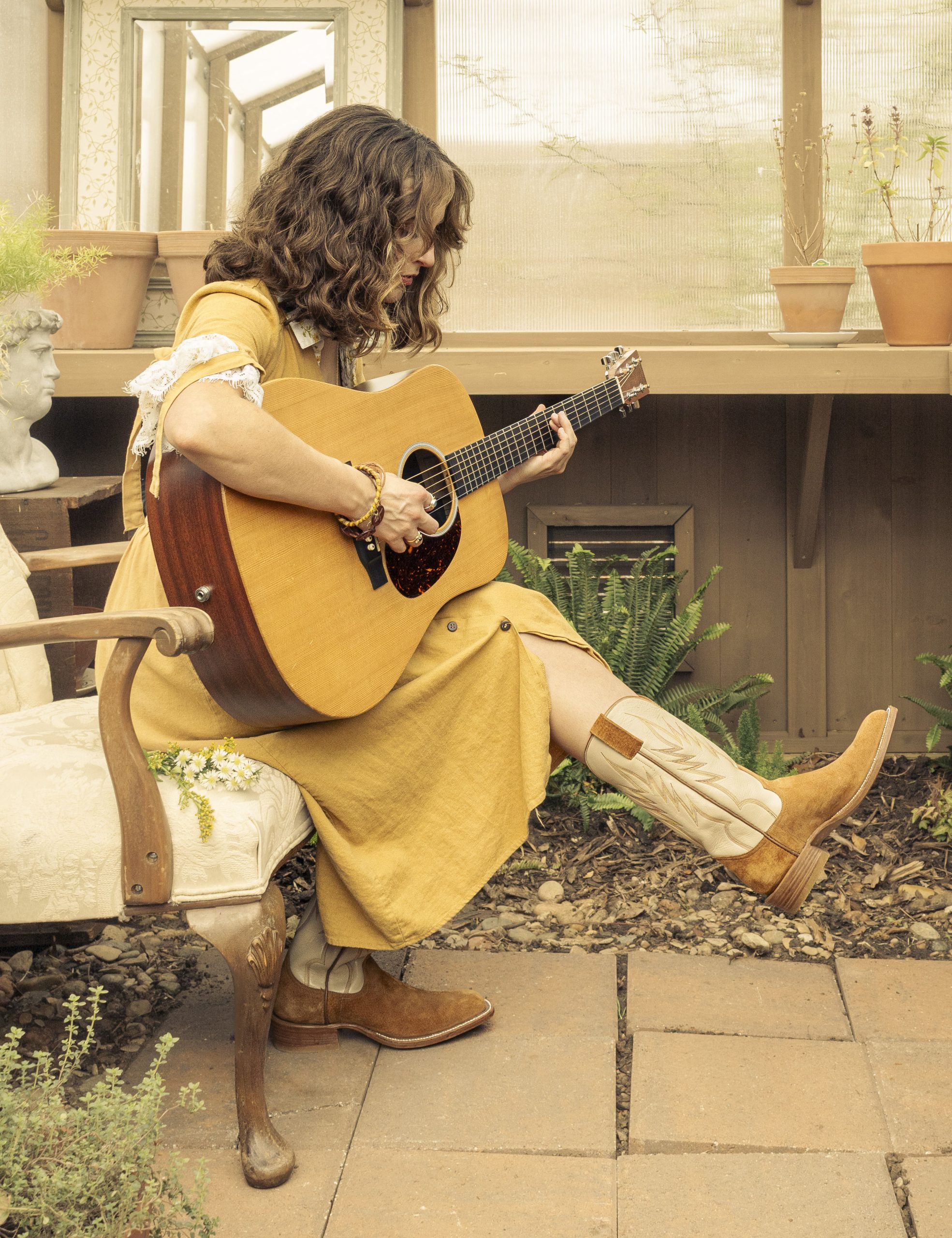
“I’ve grown accustomed to moving, to embracing those types of changes, but I’ve grappled with that too,” she says. “I didn’t realize how much those themes worked themselves into my songs until I endeavored to make this EP, but I’m not surprised to find them there.”
Places become more than settings in these songs. They hold people, relationships and earlier versions of Danel herself. “To the Sea” reaches toward the locations where she has felt most settled. “Elm Avenue” returns to Colorado while grieving one of the most important people in her life.
“They’re both tied to geography,” Danel says. “They both remember.”
The songs consider what it means to leave somewhere, return to it or carry it forward after the place itself has become unreachable. Danel has spent much of her life watching people establish a sense of belonging under changing circumstances.
“I have had wonderful examples in my life for what it looks like to make a home wherever you find yourself,” she says. “I’m learning to do that in my own way now.”
The musical world surrounding these stories was not fully established when Danel began writing them. Each song started with her voice and an acoustic guitar. The banjo, mandolin, fiddle, upright bass, piano and flute arrived later, as Danel and producer Paul Demer began listening for what each composition required.
“It was a matter of discovery for sure—sitting with the songs and listening for what would suit them, what they were telling us, if you will,” she says.
Piano and flute were Danel’s first instruments, while she fell in love with folk and bluegrass instrumentation when she began writing songs. Their appearance on the EP connected different periods of her musical life without pulling attention away from the words.
Danel and Demer initially bonded over their shared interest in 1970s folk rock. From the beginning, they agreed that the arrangements should preserve the directness of the songs rather than bury them beneath production.
“Both of us felt passionately about keeping acoustic instruments and storytelling at the forefront of the recordings,” Danel says.
The resulting arrangements expand beyond the way she originally performed the material, but the songs remain close enough to their acoustic beginnings that each instrumental choice feels connected to the story. The recording process also gave Danel a new framework for performing them.
“We ended up with a musical world that I’ve now been exploring in my live performances,” she says.
That world developed gradually. Danel first approached Demer about producing “Sunshine Girl” and “And My Eyes Aren’t Closed.” After recording began, she wrote “Wandering One,” and the possibility of a larger project started to emerge.
“‘Wandering One’ felt like a chapter title for what ‘Sunshine Girl’ and ‘And My Eyes Aren’t Closed’ explore,” she says. “All of a sudden, we had our Track 1.”


Melody usually arrives before language in Danel’s writing, but the connection between these five songs ultimately became clear through their lyrics. Once the central group had taken shape, the sequencing helped determine how the individual stories would speak to one another.
“To the Sea” provided a necessary release after “And My Eyes Aren’t Closed,” while maintaining the record’s interest in longing and displacement. “Elm Avenue” brought the EP toward its most personal act of remembrance.
“Each song carries its own story, but thematic undercurrents link them,” Danel says.
Those connections were strengthened by musicians who heard possibilities Danel had not initially imagined. “Elm Avenue” was the least predetermined arrangement of the sessions. The song had been written around the minimal guitar phrase heard at its beginning, leaving Danel and Demer with considerable room to decide what the finished recording could become.
“Production felt like a wide-open space,” Danel says.
They sent the song to Bailey Warren Zahurancik, who also played fiddle on “Wandering One.” Danel and Demer offered some loose direction but encouraged Zahurancik to interpret the song freely across several takes.
What came back shifted Danel’s understanding of the track.
“She sent back an incredible couple of passages that were so different from what I initially thought that recording would hold,” she says. “They opened up the landscape of the song vastly and perfectly.”
Rather than distracting from the memories inside “Elm Avenue,” Zahurancik’s playing gave them greater definition. The fiddle allowed the arrangement to hold the scale of the Colorado landscape while remaining close to the person Danel was remembering.
“Bailey’s interpretation of ‘Elm’ brought those Colorado memories to life in just the right way,” Danel says. “It was the finishing touch on the entire project.”
Alongside her music, Danel is studying clinical mental-health counseling. The two disciplines share an interest in how people understand experience, although neither always offers the clean conclusion a person might prefer.
Danel was initially drawn to songwriting because it helped her define emotions, stories and ideas. Her counseling studies have made her more attentive to the value of curiosity, careful language and perspectives beyond her own.
“I’m learning that this skill can be such a benefit in a counseling relationship as well,” she says. “And vice versa—I am learning skills in my studies that work their way into and benefit my writing.”
In both practices, Danel is interested in reaching the center of an idea without assuming she already understands its full shape. That means asking what else might be present in a story and allowing the first explanation to remain incomplete.
“Studying clinical mental-health counseling has also helped me to recognize that some things don’t get resolved as neatly as we may like, or may take some time to get there,” she says. “I’m grateful for that.”
Her instinct as a songwriter is often to use the song to solve whatever prompted it. Sunshine Girl became stronger when she stopped requiring each piece to provide a definitive answer.
“It serves my writing to allow for uncertainty in the process,” Danel says. “There’s usually more to an idea than what I initially realized. I only discover that when I hold my expectations for the song a little more loosely.”
Danel is still studying counseling, still learning what optimism looks like after grief and still working out how to establish a home after a life shaped by movement. She is also taking the musical world developed with Demer and the EP’s ensemble into her live performances.
“The more I pursue both passions,” she says, “the more each informs the other.”