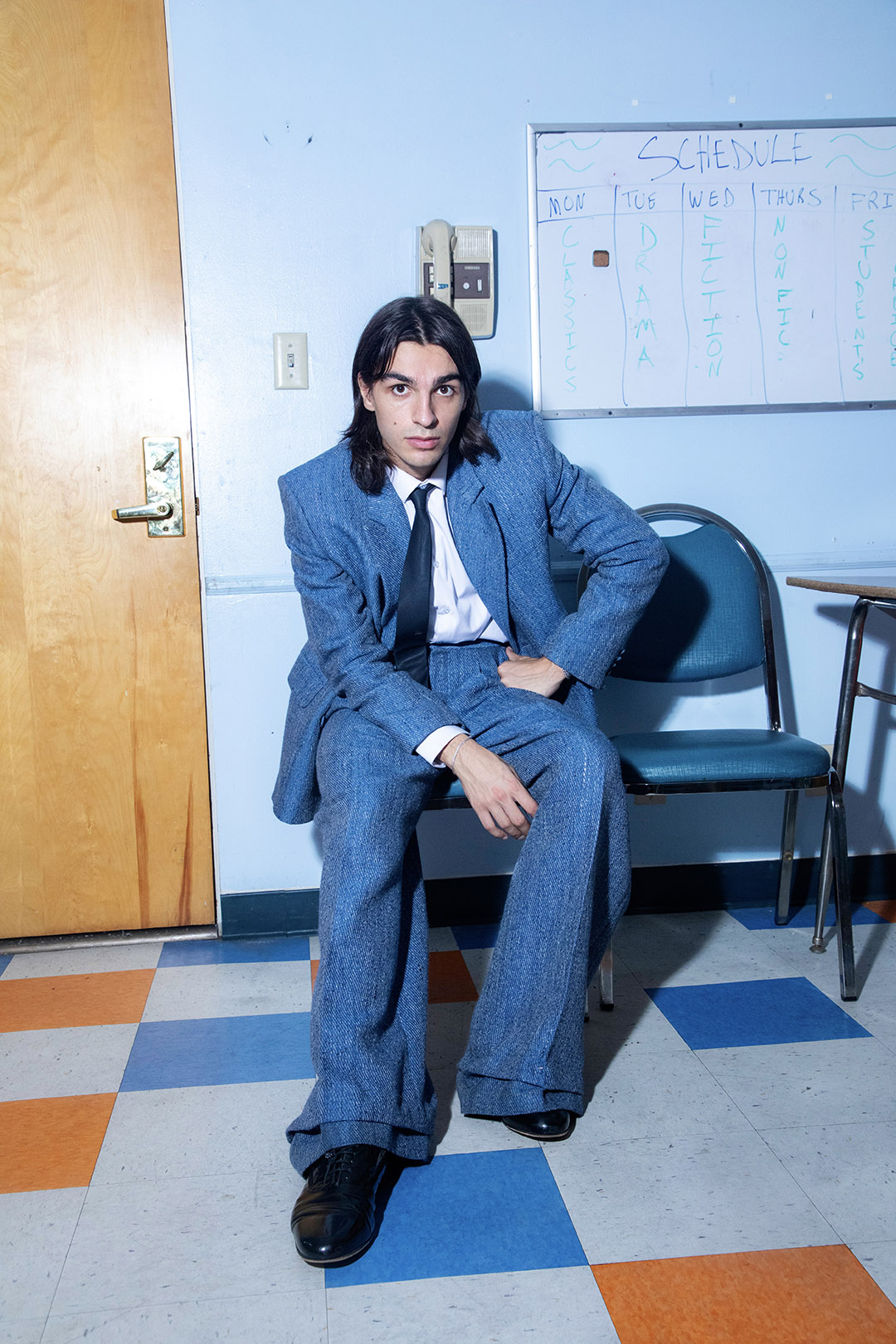
greek Is Learning When to Let Go.
greek learned how to make music by needing to know how to make music. Not in the abstract sense of wanting to become a better producer or understanding the machinery behind a record, but because growing up in Martinsville, Virginia, there simply was not much of an infrastructure waiting around for him.
– WORDS BY CJ • PHOTOS BY JACKSON LEFT
If he wanted to write something, record it, shape it and eventually put it into the world, the quickest route was learning how to do the work himself.
“Passion turned into necessity,” he says. “If I wanted to fully immerse myself in music and be able to do it as much as I’ve been able to grant myself now, I think just circumstantially I had to try really hard.” That instinct never really left. There was always another thing to understand, another instrument to get better at, another production problem he could solve without asking somebody else to come into the room. “Self-sustaining in my music has been something that’s always kept me interested, because there’s always something more to learn, there’s always something more to do.”
You can hear that independence in the way greek talks about influence too. Stevie Wonder, Aretha Franklin and The Beatles all sit somewhere in the foundation, but none of them arrive particularly cleanly on the other side. “Very rarely is my inspiration used in a very linear fashion,” he says. “NKL” began, at least in part, with him trying to learn a Stevie Wonder song, but the idea wandered almost immediately. The old records matter, but so does the computer, the software, the synths sitting nearby and the years of working the same way because that is simply the way he learned to work.
“I use FL Studio to produce my music,” he says. “Certain limitations and familiarities on there, until they get old, are important to kind of run through and see what limit you can take it to.” He likes the restriction of that. Too many options can make a record disappear into possibility; a few boundaries can force you to make a decision. “Having a bit of limitation is really important sometimes, because it makes you explore and define whatever creativity is within those bounds.”
That sounds tidy enough now. It was probably less tidy while he was making Accelerator.
greek wrote somewhere between 20 and 30 songs while trying to work out what that record was supposed to be, and there is an obvious difference between knowing how to make everything yourself and knowing when to leave something alone. If you are the writer, producer, engineer and final vote, there is technically nothing stopping you from touching the song forever.
“I empathize and understand a perfectionist very well,” he says. “But there is a point in time in which there’s only so much you can do in your own incubation chamber, making your own music, doing your own thing.” Eventually, he says, you have to be willing to call it. “For this point in my life, for how much I’ve done, this is what I’m going to release. This is the best I can do right now.”
Accelerator seems to have taught him that lesson the hard way. He talks about the record as something that had to survive several different versions of himself before it could exist at all, the music changing alongside everything else happening around him. “It took me a couple of versions of me shedding some skin to kind of figure out what I was going for,” he says. By the time it was finished, the record felt less polished into existence than dragged there. “A beaten and bruised, in a good way, version of it.”
That is part of what makes Dance Break feel so immediate. It is not that greek suddenly stopped thinking about what he was doing. If anything, it sounds like somebody who had thought about things so much that he finally understood where thought stopped being useful.

He has spent much of the year touring, and Dance Break carries that movement with it. The songs are compact, physical and deliberately easy to live inside. “I really wanted to make and play some music that feels defined by that,” he says. For somebody who has mostly gravitated toward larger projects, four songs became enough. “I look at those as kind of a lovely bite-size of this time in my life.”
“Hold Me” is probably the clearest example of what makes the EP work. The lyrics are full of longing, but the song itself refuses to sit still. greek says he does that more than he realizes, putting emotional weight against production that wants to move in the opposite direction. “I quite often will juxtapose my writing and my production without even realizing it sometimes,” he says. “Sometimes I think there’s a beauty in writing a song that makes you feel some type of way, but at the end of the day you just want to groove.”
“Sometimes when you’re in your feels you still gotta have a good time.” That sentence probably explains more of Dance Break than anything else.
The timing matters too. greek’s world is larger now. There are more shows, more travel, more people around him, more things pulling at the same hours of the day that used to belong almost entirely to making music. None of that is bad. It is, in most ways, exactly what he spent years working toward. But success has a strange habit of occupying the space you thought it was going to create.
“I’ve been trying to just be more protective of my time, my life, the things that are going on,” he says. “I always want to value my music and my art first, and I think that’s the thing that keeps any of this important and going.” The rat-race part of being an independent artist is something he knows well. Work more. Learn more. Make more. Push harder. It got him somewhere, but there is a point where the thing that keeps you moving can also start sanding away the reason you wanted to move in the first place. “Something that I’ve learned is I just need to take the right time when necessary to not lose the fun of music,” he says. “Don’t let it override you and do too much when you don’t really want to.”
That lesson has started appearing inside the studio too. Dance Break marks one of the first times greek has allowed another producer so deeply into the process. His friend Charlie came into the songs at a point when greek felt like he was racing toward the finish line and somehow getting no closer to it. For somebody who learned music through self-sufficiency, there is probably no more obvious sign of change than realizing that doing everything yourself is not automatically the same thing as doing it better.
“It gave me the confidence to know that in the future I’ll ask for that kind of thing more,” he says. “It’s very fun to have someone fully involved in a project with you.” More importantly, the songs proved the point for him. “These are some of my best songs to date, and that’s not by accident.” He calls it taking baby steps into collaboration, which feels funny considering how natural the results sound. But it makes sense. When independence becomes part of how you understand yourself, inviting somebody into the middle of the process can feel less like delegation and more like giving something up.
greek is starting to see it differently. “Collaboration is something that pushes culture and community and music forward,” he says, “and I shouldn’t be so afraid to do it.”
The funny thing is that just as Dance Break arrives, he already feels himself moving away from it. He has been writing toward another full-length record, and what he is making seems to be heading somewhere noticeably different. The EP may end up becoming less of a new direction than a last look at one.
“I think I was making music in that vein because I knew I was pulling away from that,” he says. “Some part of me wanted to push that kind of sound out there as a final moment of that dance music for some time.” That constant movement has been there from the beginning. Early comparisons to Frank Ocean, Daniel Caesar and Omar Apollo made greek more conscious of needing to define himself, sometimes pushing him further into electronic territory simply because he wanted to hear the edges of his own sound more clearly. He is less defensive about that now. “Being compared to someone like Frank Ocean, even just vocally, that’s a beautiful thing to hear,” he says. “Early on, when I wasn’t so confident in what I’d done with the music I’d put out, it was definitely something I had to figure out how it made me feel.” Confidence has made those questions less interesting. The sound can move because he no longer seems as worried about somebody else telling him what it is.
The same distance that gave him that confidence has complicated the way he thinks about home. greek left Martinsville because, like plenty of people raised in small towns, leaving felt like part of the point. “When I lived at home, all you want to do is leave home,” he says. “All you want to do is go explore the world and figure out what’s going on.” He has lived in Los Angeles for close to five years now. It is his community, his base, the place where the life he went looking for actually started happening. And still, somewhere along the way, Virginia got louder. “I have such a deep, larger appreciation for home than I think I ever have now,” he says. “I often am thinking about home and how much I miss it. There’s something about just where you’re from.” When he goes back, he notices the simple things differently. The things that barely registered when they were ordinary have become the things he reaches for. That feeling runs through “Virginia Creeper,” but it has started bleeding into the larger way he writes too. Home has become easier to see from a distance.

“I’ll be reminded of the simple things and what I appreciate about it,” he says. “It’s something that I often put in my music, to say the least.”
greek spent a long time learning how to do everything himself because, for a while, that was what moving forward required. Now the more interesting questions seem to be about what happens after that: when to stop, when to let somebody else in, when to leave a sound behind, and when the place you spent years trying to escape starts looking a little different in the rearview.