TRVR? Is Finding His People, One Song at a Time.
After years spent refining his music alone, the Fort Worth songwriter is finding a different kind of freedom in a full band, the working-class folk tradition and the city that helped him recognize his own voice.
– WORDS BY CJ • PHOTOS BY Amani
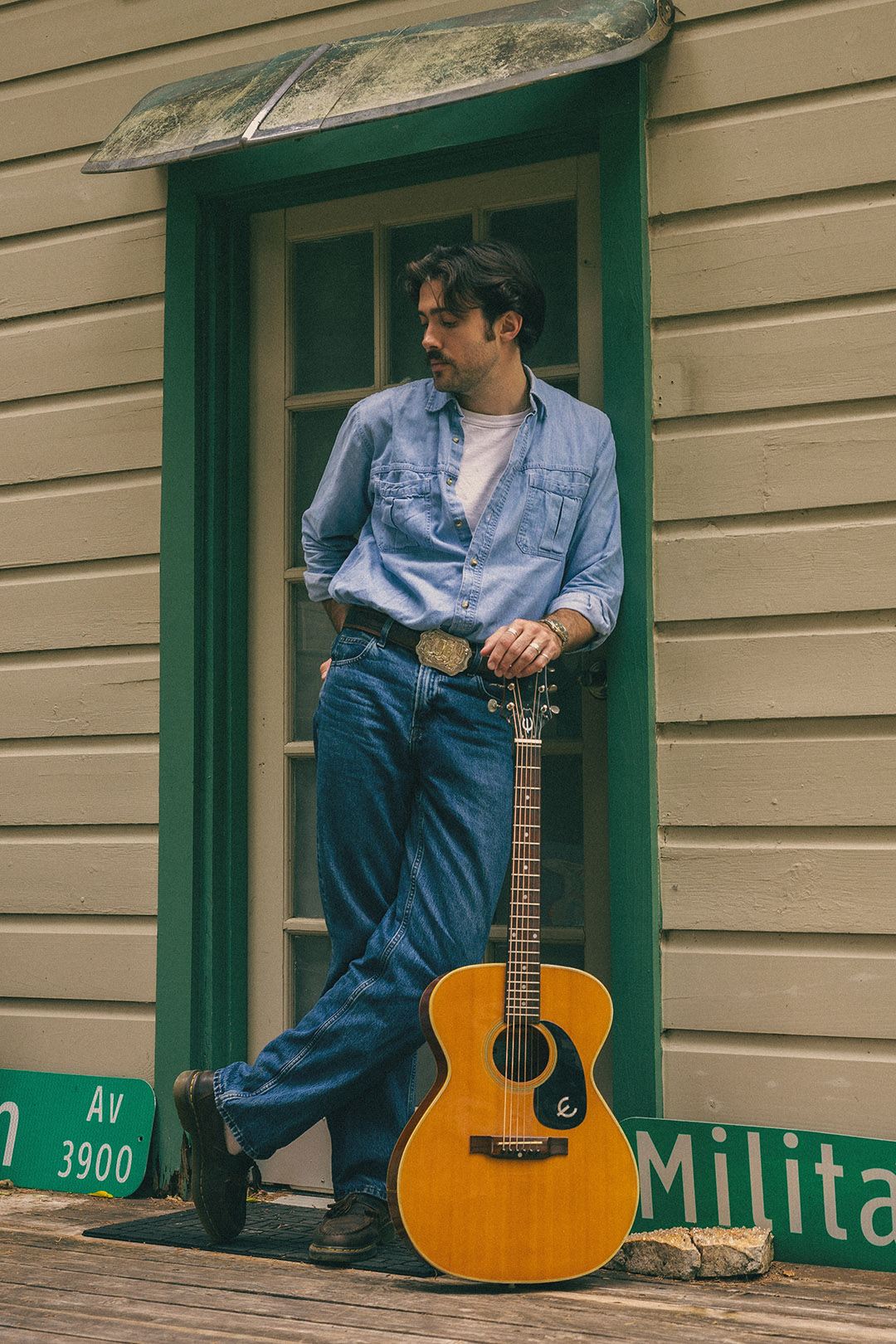
There is a song in TRVR?’s catalog called “See You Again (Tulips),” and if you know Fort Worth, it is tempting to assume that the title points to the music venue on St. Louis Avenue. But the real story begins with a flower. “That song was actually named ‘Tulips’ because that was her favorite flower, so I thought about her every time I saw them,” he explains. “But as time passed it has since always made me think of my favorite Fort Worth venue!” A song written around the memory of one person has gradually acquired another connection, to a place where music and people continue to meet. It’s an apt starting point for a songwriter reconsidering how much of himself, and how much of the city around him, belongs in his music.
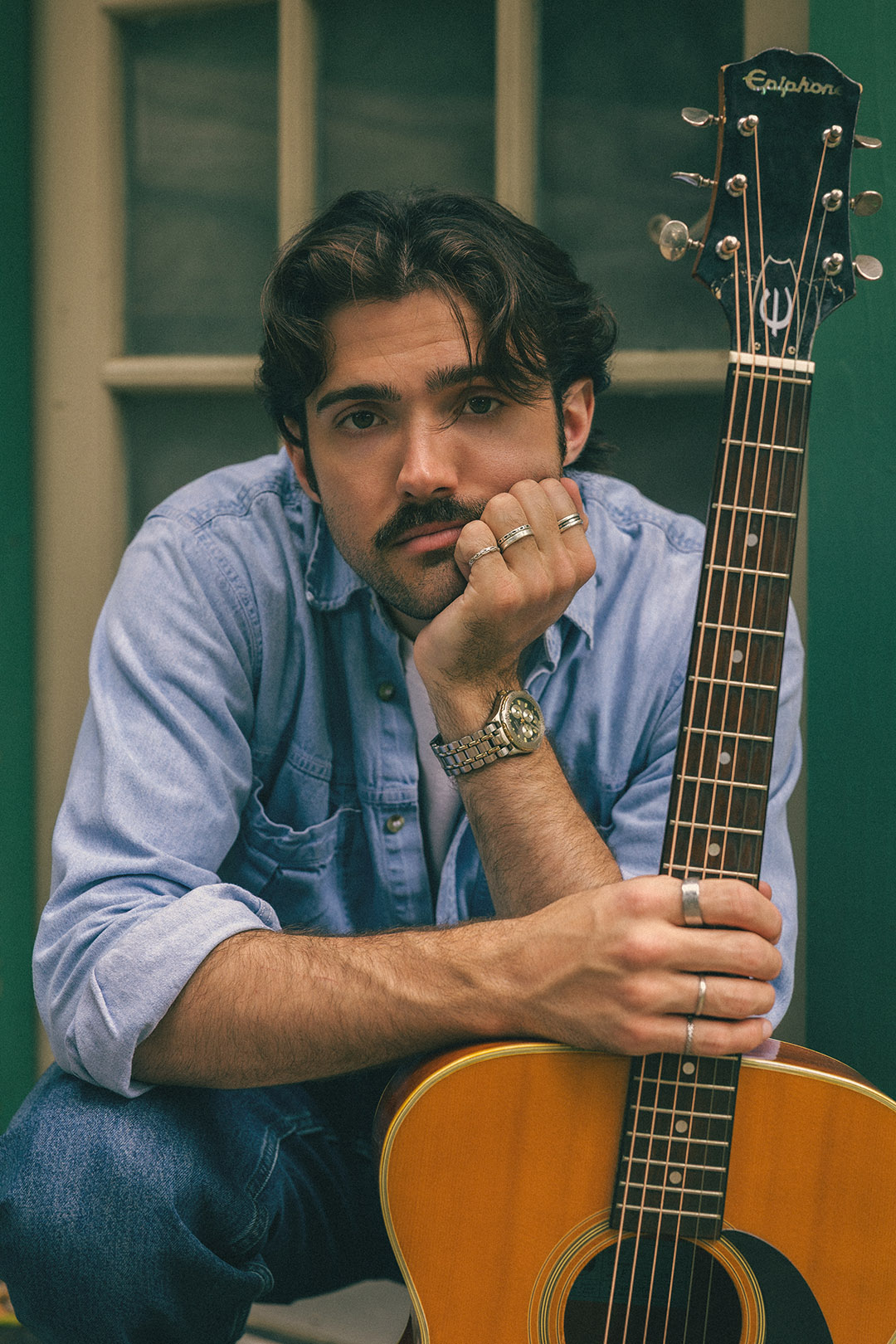
Trevor Douglas, who releases music as TRVR?, grew up absorbing the hooks of 2010s pop and became adept at constructing songs himself. He appeared on American Idol as a teenager, and his career has since taken him through major opening slots, Los Angeles and years of independent recording. His 2024 project Just Peachy represented a deliberate attempt to establish an identity, but listening back, he hears the person he was trying to become. “I wrote all of those songs while I was living in LA, and I think you can hear it,” he says. “There’s a certain bedroom pop, tiktok algorithm sound I was going for at the time. It’s funny though, because the sound is exactly what I wanted, but nowhere near who I am anymore.”
He felt pressure in Los Angeles to match an idea of what his music was supposed to be. “While I love LA, I didn’t like how the city spoke through me in my songwriting,” he says. “I felt as though I was trying to be someone I wasn’t. Fit into a mold being made for me.” Returning to Fort Worth changed that. “As soon as I moved back to Fort Worth, my songs got much more honest.” His next album will draw more openly on his Texas upbringing, family and personal life.
That honesty is apparent in A Thousand Small Goodbyes, the three-song release he put out in 2025. “Hope You’re Happy,” “See You Again (Tulips)” and “Not Enough” approach the aftermath of a relationship through details that return unexpectedly, long after the larger decisions have been made. “Each of these songs have references to specific ‘small goodbyes’ for that person,” Douglas says. “For a fact focused, pragmatic person I am such a hopeless romantic. I still say small goodbyes to a lot of people everyday.” What remains isn’t necessarily the wish to recover a relationship; sometimes it’s affection for someone as they once were. “When you truly and deeply love someone, that love never goes away in my experience. Even if they change, you will at least always love the person they were when you were with them.”
He kept returning to a line he’d heard: “We are a museum of everyone we’ve ever loved.” It became his North Star for the project. Elsewhere, listeners have taken “better off alone?”, a song he wrote about social isolation, as something to help them through a breakup. He welcomes the different readings.
Lately, the world beyond his relationships has been moving into the foreground. Douglas has been spending time with Bob Dylan, Joan Baez, Woody Guthrie, Pete Seeger and John Denver, following a tradition that treats ordinary lives and public concerns as worthy subjects. His explanation is blunt. “Contemporary art has felt so soulless recently. Everyone seems afraid to make any statement that might upset the status quo… but the status quo sucks right now man. Everything is so expensive and the rich just get richer while profiting off our poverty.” Folk music recognizes the connection between private hardship and the conditions that produce it. “I respect how much older folk music spoke their mind and was the music of the working class. They had so many of the same problems we did.”
The route into that tradition wasn’t academic. At Dollywood in 2024, Douglas learned about Dolly Parton’s life and reconsidered the politics inside a song almost everybody knows. “9 to 5 is a VERY pro worker song about how our bosses take all the surplus value we generate haha!” he says. He began tracing folk music’s history, and the Bob Dylan film brought its leading figures into sharper focus. Meanwhile, he was in a happy relationship and the familiar reservoir of breakup material wasn’t providing much inspiration. “So I thought to myself, ‘what else makes me really upset… oh! Society!’ and I started the new record haha!”
There is humor in the telling, but little ambiguity about what he means. Douglas has been advised that political songs might drive audiences away. Yet after performances in the Fort Worth Stockyards, people he hadn’t expected to agree with him have approached to express appreciation. “A huge part of my message is being pro working class,” he says. “I have way more in common with an average working class conservative than I do any billionaire or politician who abuses the system and us. I see every member of the working class as my ally even if they don’t know it yet.” The possibility that a song might cross a political division is reason to sing it, not soften it. “Music has such a powerful capacity for change and unification. I want to do everything I can to facilitate that.”
His writing has changed alongside his approach to recording. Douglas spent years as a self-contained operation, writing, recording, producing and mastering “GONE” entirely himself. But when every sound is yours to change, it can be difficult to finish. “I’m so bad at leaving a song alone,” he admits.
“I sat on ‘A Thousand Small Goodbyes’ for years tweaking it.” This time, he wants other instincts in the room. “For the first time ever I don’t have to write every drum beat, bass line, guitar riff myself anymore. I get to write the song and hand it off to my band to see what they can do with it. It’s been super fun bouncing ideas around and letting the song shape itself.”
His performances with loops and multiple instruments have long shown what he can do alone. But a band offers different responsiveness. The new songs have been played repeatedly at gigs around Fort Worth, their arrangements changing through performing together. Douglas wants the recording to retain that quality, rather than assemble individual parts afterward. “My goal is to capture that live sound for the record by having us do it all in one take in a room together, like they used to do it 50 years ago,” he says. “I think that live performance aspect injects so much life into a recording. Every person responding in real time to the changes in the music, no metronome, we’re just letting the song breathe like it’s a living person.”
He is frank about how improvised his career has been. “I feel like I’ve always been flying by the seat of my pants with my career. Just following wherever the wind takes me.” Now he wants to record a full album with his band and take it beyond Fort Worth. “I want to slow down though and properly record an album at a studio (instead of in my bedroom), with gear I could never afford, and tour that album. Take it around to new people every night.” There is still a meticulous producer in him, and an ear for the pop melodies he loved growing up. But he’s increasingly willing to let other people change the outcome. “I’d like take the tried and tested system on the road,” he says. “And then do it all again the next album.”