FRONT & CENTER
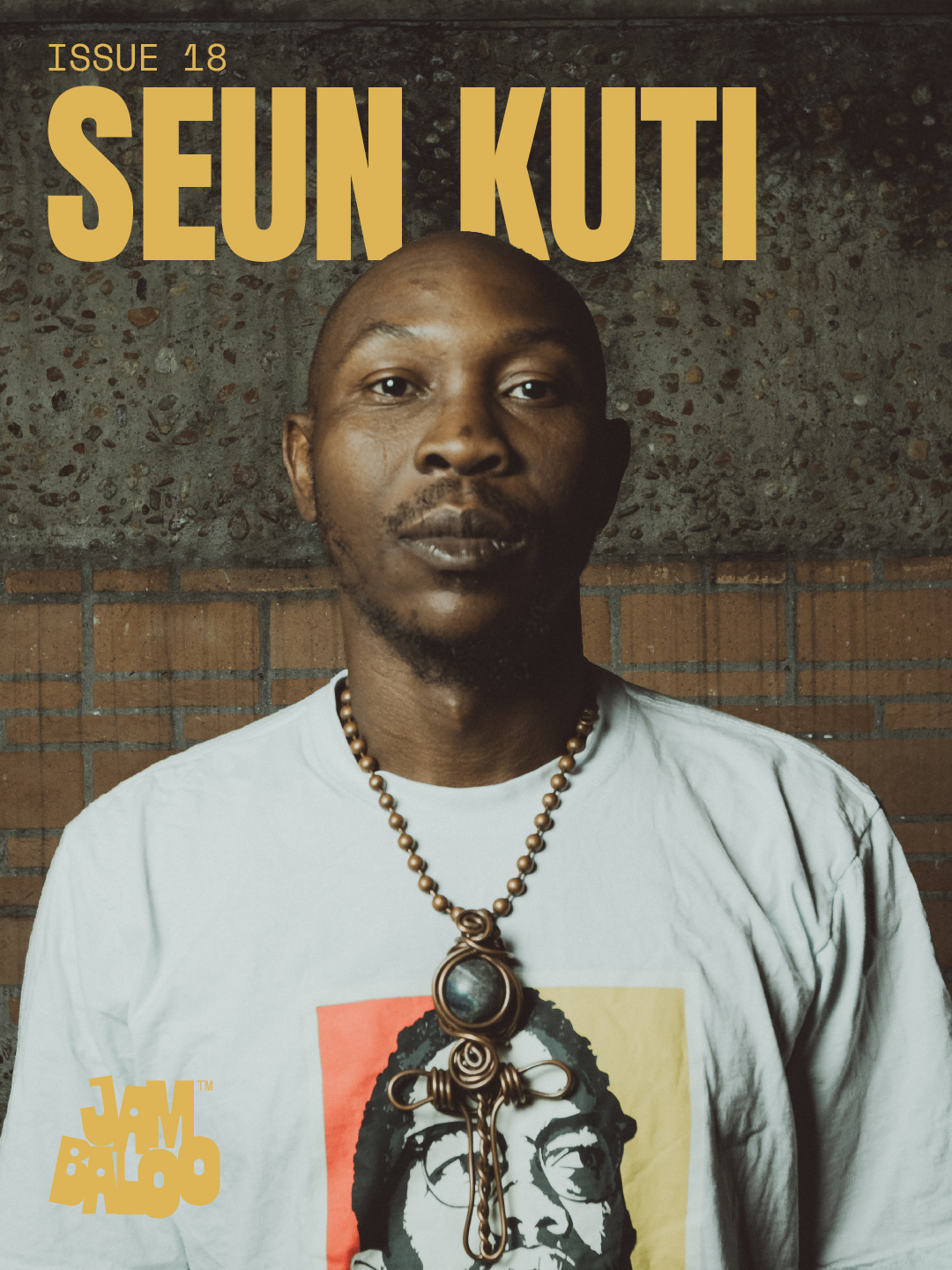
Seun Kuti: Music Is the Weapon for the Battle.
The Egypt 80 leader talks about his unplanned new album, writing with his daughter, the limits of music, and how the band might continue without him.
– WORDS BY CJ
Seun Kuti is sitting in the room he calls the revolutionary area of his house when he reaches for a notebook. It is where he reads, thinks, and writes down ideas that might eventually become songs. He also records melodies and grooves as they occur to him, looking for places where the music and the words fit together. Over the next half hour, he talks about writing with his daughter, the politics of everyday life, the way musicians work together, and what happens when the leader of a band no longer wants to be its center.
His latest album with Egypt 80, Na Dem, was released November 6. Produced by Femi Koleoso of Ezra Collective and recorded in cities including Lagos, London, Paris, and Rio de Janeiro, it features Tom Morello on the title track and Jamaican artist Kabaka Pyramid on “Problems.” Kuti has spent most of his life in Egypt 80, the group his father Fela led until his death in 1997, and has long since established his own way of working within it. Yet Na Dem begins somewhere unusually intimate: with the voice of his daughter Adara.
“She made me write it,” Kuti says. “She wanted us to do a song together.” Her voice opens “Adara,” and she also sings backing vocals. He was careful not to turn her request into another song that simply happened to feature his child. “I didn’t want it to be too me… I wanted it to be us.” The song moves from a father’s affection toward the kind of future he believes children should be entitled to have. Kuti describes its underlying argument as parents caring enough to demand better lives for their children, even when that requires real sacrifice. Adara’s name, he explains, can be loosely understood as “it will be well.” For an album concerned with inequality, corruption, and the behavior of those in power, this is his chosen opening. “It’s a prayer and it’s a wish,” he says. “And also, you know, it’s a call to action.”
Kuti wasn’t meant to be making another album yet. There was no release window prepared, and with no block of time set aside to record, he started working wherever his travels took him. “There was no space in the calendar really to record,” he explains.
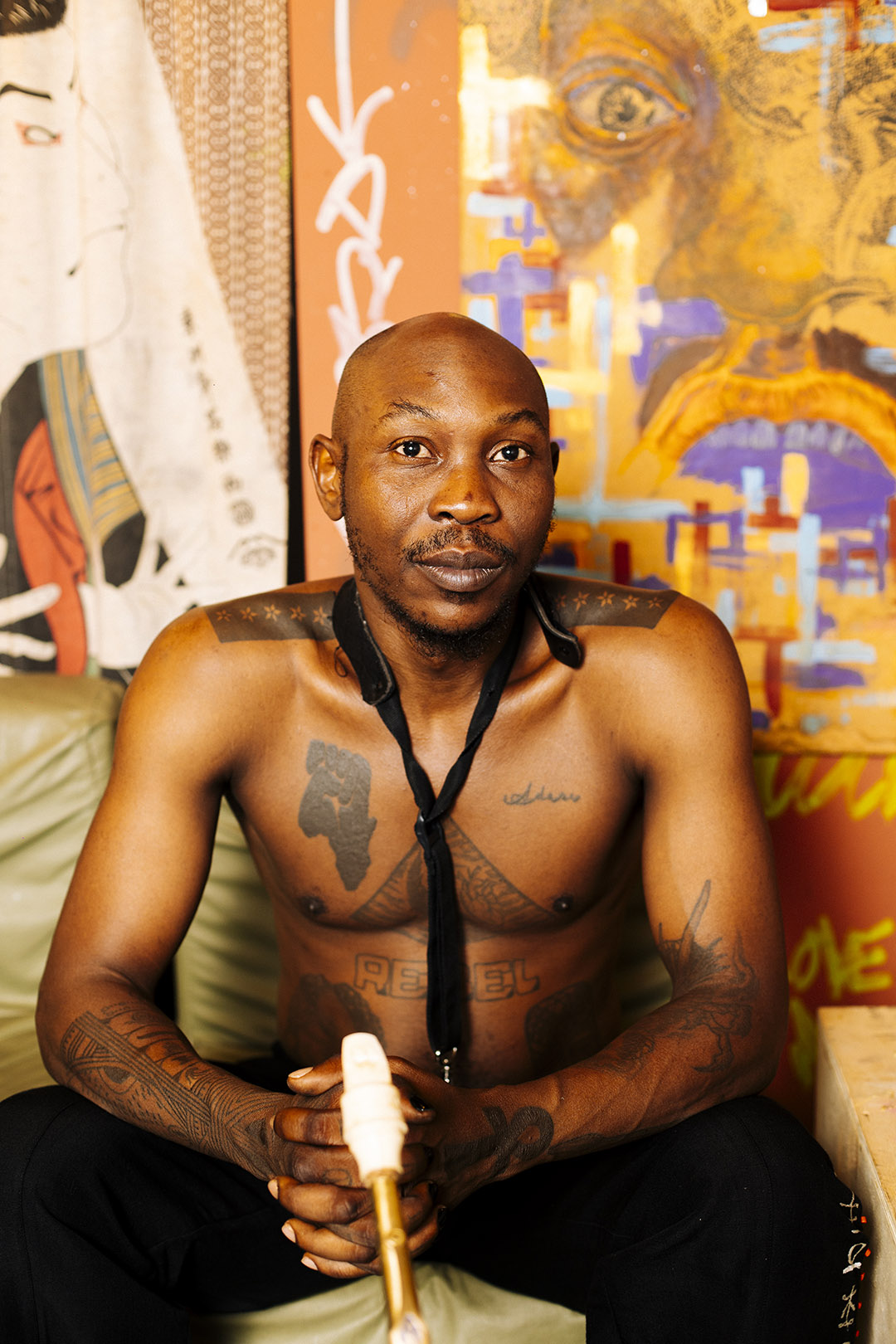
PHOTO BY Virginia Santos
“So I was just recording everywhere I went.” Once the songs were finished, the schedule would have to catch up. “I’m recording, and when I finish, I’m done. You guys, you know, get ready to start releasing shit.” More material is already coming to him, and he is trying to resist it for a while. “Right now my mind feels like it wants to write again,” he says, “but I am making an executive decision to say, ‘Man, I need to rest.’” With so much happening in the world, he wonders whether his mind is taking in more than it knows how to process except through music.
Asked whether a melody sometimes pulls him toward an unexpected political subject, Kuti answers with a comparison to lawyers in a courtroom. “I never ask questions I don’t already know the answer,” he says. His collected thoughts and musical fragments usually find their matches over time. Occasionally the two arrive together, but he considers that rare. With “DJB,” whose title stands for “Devil Just Busy,” the thought came from watching powerful people behave with what he sees as a disregard for humanity. The phrase makes a sharper point in Nigerian Pidgin than a literal English translation would suggest. The devil isn’t merely occupied; he is relentlessly busy, with wrongdoing everywhere. Kuti connects the idea to the Brazilian educator Paulo Freire and his argument that those who dehumanize others damage something in themselves as well.
When asked what Koleoso brought to the studio, Kuti questions the premise. He thinks musicians and listeners pay too much attention to the idea of one collaborator arriving to supply something missing from another’s work. “What we share is an energy,” he says. “I believe that death rock metal is Afrobeat with lots of distortion,” he offers, “and Afrobeat is death rock metal with African grooves.” The assertion is intentionally provocative, but his larger objection is to the habit of treating genres as rival camps. To him, musical categories become another means of imposing competition on work that might otherwise be cooperative. “Every sound, every music, every musician is intertwined,” he says. “The whole musical thing is one big family.” Morello, Koleoso, and the members of Egypt 80 meet each other as musicians rather than representatives of separate territories. “What happened was a musical cooperation,” he says of Morello’s contribution. “I love Tom. We cooperated as artists.”
The discussion of musical community leads unexpectedly to Ireland. Kuti mentions John Reynolds, the Irish musician and producer he describes as a musical brother, and then Damian Dempsey, one of his favorite Irish artists. He and Dempsey have spoken on the phone many times and attended each other’s concerts, but have somehow never managed to meet face-to-face. It is a funny example of the informal relationships Kuti values, with no formal collaboration or tidy story about one person changing another’s sound.
On “Problems,” Kuti and Kabaka Pyramid take the daily irritations and stresses of life and connect them to a larger sense that ordinary people are being squeezed. Asked how he finds the connection between a personal frustration and the political structures around it, he rejects the idea that the two begin as separate things. “Life is deep thought,” he says. “Life without deep thought is empty.” For Kuti, politics means more than voting or choosing a party; it is the act of looking seriously at the conditions of your life. He reaches for an image of the body, with its organs depending on one another to function. If the heart decided to keep all the blood for itself, he says, the whole body would become sick. Society, in his view, works by similarly unavoidable relationships. “There’s always a thread that leads it from you to everybody,” he says, “and that thread is always quite visible.” Some people decide to ignore it. He would rather put it in a song, even knowing that someone will object. “You cannot make everybody happy,” he says. “You are not jollof rice.”
His music carries political demands, but Kuti doesn’t believe a performer can simply deliver a record and expect everyone listening to reach the same conclusions. “You cannot expect everybody to be where you are consciously,” he says. “I will not disrespect you because you do not know. My job is to share with you and hope that it connects or one day it connects.” Ideally, a listener will leave an Egypt 80 performance more politicized and more willing to act. If that doesn’t happen, he is prepared to keep trying. The music can still give people something valuable when its political argument doesn’t immediately land.
His father famously described music as a weapon, a phrase that has followed Egypt 80 for decades. Seun has his own addition. “Music is the weapon, but not the battle,” he says. Songs can help prepare people for change, but the work itself eventually belongs to people in other professions and communities.
PHOTO BY Virginia Santos
Lawyers will have to pursue justice, journalists will have to confront lies, teachers will have to help people think, and health workers will have to value human well-being above corporate profit. “Music can only inspire the minds that will change the world,” he says. He talks about building tools for struggles that may not have fully begun yet, giving future participants a language and an energy to draw on when their moment comes. “Just because the battle is not happening does not mean we should not forge the weapons.”
The final question returns to Egypt 80 itself. Its history is inseparable from the Kuti family, and Seun has led the group since he was a teenager. Asked whether he can imagine the band existing beyond his leadership, he says he wants both to preserve its political purpose and create a structure capable of keeping it alive without relying on one person.
“I want the time to come where there will be artists that are as dynamic and revolutionary as needed for humanity’s struggle,” he says. “And I want those artists to see Egypt 80 as a lighthouse.” He imagines musicians coming to the band as an institution, carrying its purpose forward through their own work rather than simply preserving the sound of his father or himself.
The conversation has run over its allotted time but Kuti delievers one last instruction before his goodbye – “Keep fighting in the battleground of truth.”