INTERVIEW
Tove Styrke and the Woman in the Apartment.
For a good portion of the time Tove Styrke was making her new album, she thought she was writing about somebody else. She’d been growing vegetables on the roof of her apartment building, writing little poems up there and gradually accumulating material that seemed to belong to something larger.
– WORDS BY CJ
An image came to her of a woman alone in an apartment, surrounded by hundreds of people going about their lives on the other side of the walls. There was something about the woman that Styrke wanted to understand, although she couldn’t have said at the time what it was. She spent the next couple of years following her through a story that would eventually occupy sixteen songs, only to discover, as she began putting those songs out into the world, how closely the woman’s life resembled her own. The album she’d originally called The Afterparty acquired a new title: I thought this story wasn’t about me.
“Making this album felt more like discovering something than coming up with an idea,” Styrke says. “I was working intuitively, collecting pieces that would eventually become part of a much bigger picture.” She talks about the woman in the apartment as though she were an image in a film that she’d paused and spent an unusually long time looking at. There was information in it that she hadn’t been able to process on first seeing it, and the writing became a way of finding out what else was there. The idea that a songwriter might spend years working on something without fully understanding its significance is particularly interesting in Styrke’s case, given how meticulously she went about building the physical and emotional environment of the record. She knew an enormous amount about how she wanted this thing to sound long before she knew why she needed to make it.
The story unfolds over the course of a night, and Styrke is very good at capturing the peculiar instability of those hours. On “Song and Dance Man,” the night is still full of possibility; by the time we get to “Let’s Go Camping,” the circumstances have become considerably stranger.
There’s a familiar feeling in that progression for anybody who’s gone out in the evening with a fairly clear idea of what they were going to do and found themselves somewhere entirely unexpected at four in the morning. A single night can accommodate so many different versions of the same person, and when I ask her what interests her about a good night beginning to go wrong, she seems slightly amused by the question. “But isn’t that exactly what life feels like?!” she says. “You never know what’s going to happen next. And as soon as you think you have a situation figured out, it turns on its head and changes.”
Styrke’s ambition for the recording was to make music for a film that existed only in her head. She wanted to be able to suggest a physical environment through the sound of the instruments, to have the listener experience some of the distance between the people and things in it. The album was made with live instruments and analogue machines, without samples, and the position of a microphone could become part of the storytelling. A sound might seem to be coming from another room, for instance, and that changes the way you experience the music as well as the way you imagine the space around it. There’s a pleasure in listening to this record on headphones and finding your attention drawn to something that sounds as though it’s happening quite far away. Styrke wanted the sound of her film to be capable of generating an entirely different film in the mind of the person listening. “Like a canvas for people to dream and fantasise,” she explains. “We used a lot of different cues to make the listening experience suggestive, but with enough space for someone to fill in the blanks themselves.”
The business of other people finding things in her songs that she hadn’t realised were there has become quite important to Styrke. When her partner heard “Sunflower,” it was apparent to them that she’d written a song for her daughter, something Styrke herself hadn’t fully understood. She’d already done the considerable work of writing the thing, and it took somebody close to her listening to it to recognise what she’d been doing.
Photo by Martin Axell
Styrke has had similar experiences with other songs on the record, and it’s one of the qualities she values most in her writing. “They’re the songs that feel like they were already out there, and you were just present at exactly the right moment to fish them out of our collective consciousness.” She has found the process of releasing this music unusually emotional, sometimes painful, and it was during that period that she began to understand the autobiographical nature of the story. “I noticed that the process was intertwined with my emotional life in a way no other record had ever been before.”
There’s a rather funny proposition at the heart of “Me/You (always and forever),” a song about a relationship you’re effectively stuck with for the duration of your life. It’s a subject that feels particularly well suited to a record in which the distance between the writer and the person she’s writing about keeps diminishing. There are any number of songs about finding somebody with whom you can spend the rest of your life, considerably fewer about the practicalities of having to spend it with yourself. Has Styrke become a better companion to herself over the last few years, I wonder, or is she simply more familiar with her own nonsense? “I’m trying to become a better companion to myself, and I think I have,” she says. “AND definitely more aware of my own nonsense haha.”
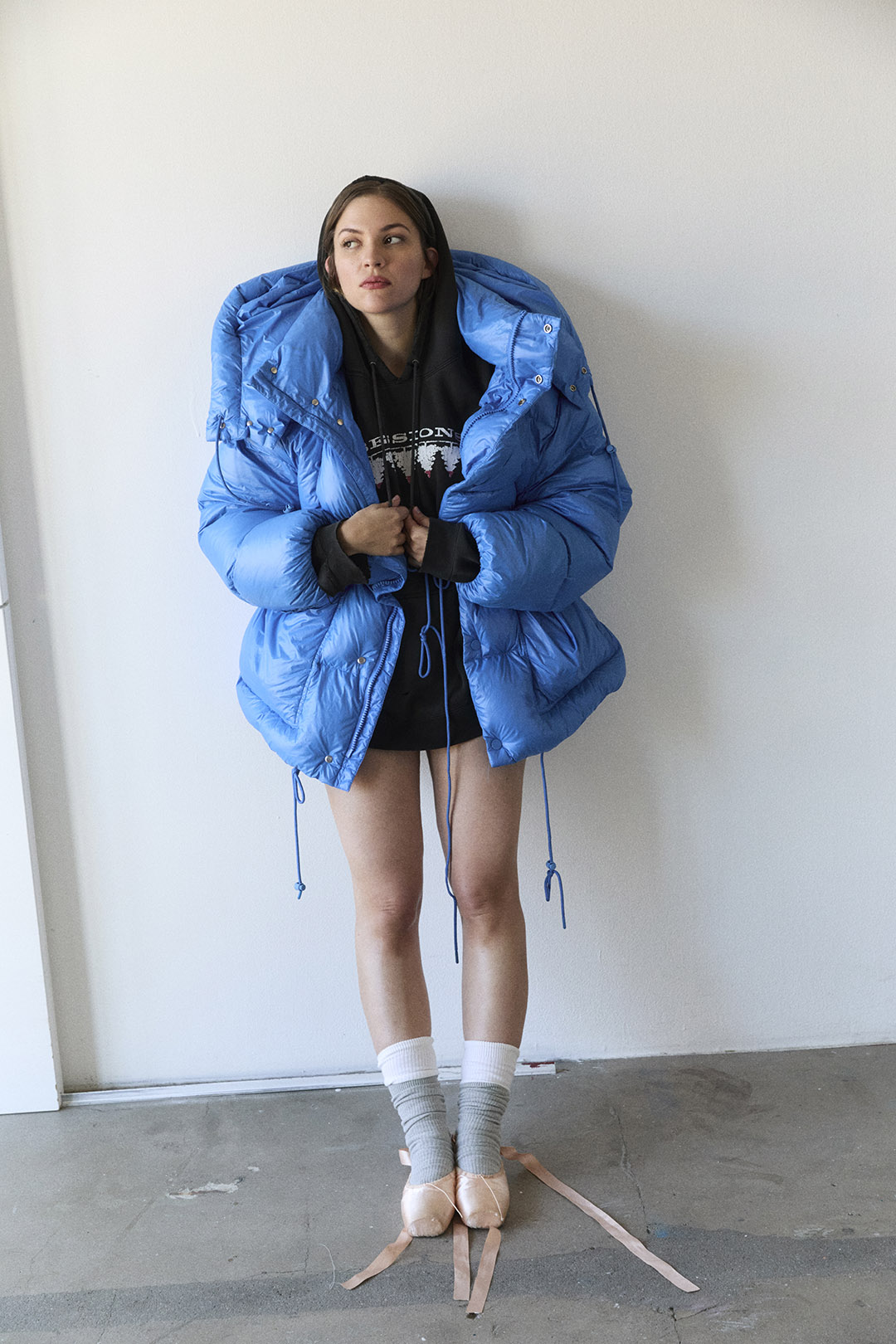
PHOTO BY Frida Marklund
During the making of the album, Styrke also spent time performing in David Bowie’s Lazarus, an experience that sent her quite deep into the work of an artist she hadn’t previously explored in that kind of detail. She was particularly struck by his willingness to keep changing how he worked, something that feels pertinent to what she’s doing now. “He was constantly evolving and exploring new ways of doing things. Totally fearless. Very inspiring.” Styrke is also making music in Swedish with Året Var, a project that allows her to engage quite explicitly with political and social issues in her own country. There’s an established tradition of that kind of songwriting in Sweden, and the context matters to her. She can talk about things with Året Var in a way that wouldn’t necessarily work within her English-language music, and she’d like to have more opportunities to exercise different parts of her artistic personality. “They inform and strengthen each other, that’s my absolute belief,” she says.
It’s been fifteen years since Styrke began releasing albums, and there’s something quite exhilarating about hearing her talk about what she’s made as though she’s only just discovered the extent of what she can do. .
I thought this story wasn’t about me is a record that takes its time, asking a listener to stay with a story across sixteen tracks at a point when artists are constantly being reminded how little of anybody’s attention they can reasonably expect. I ask whether experience has finally given her the freedom to make something this involved without worrying too much about how it’ll be consumed. “I was always free to create however I wanted, but I didn’t know until now that this was what I wanted to do,” she says. “I feel like I’ve found myself completely as an artist. From where I am now, I feel like I could make a hundred more albums.” There’s still plenty she hasn’t worked out about this one. The image she came across while she was writing those little poems on the roof continues to occupy her. “I still go back to that image,” she says. “I’m still learning what this story is about.”