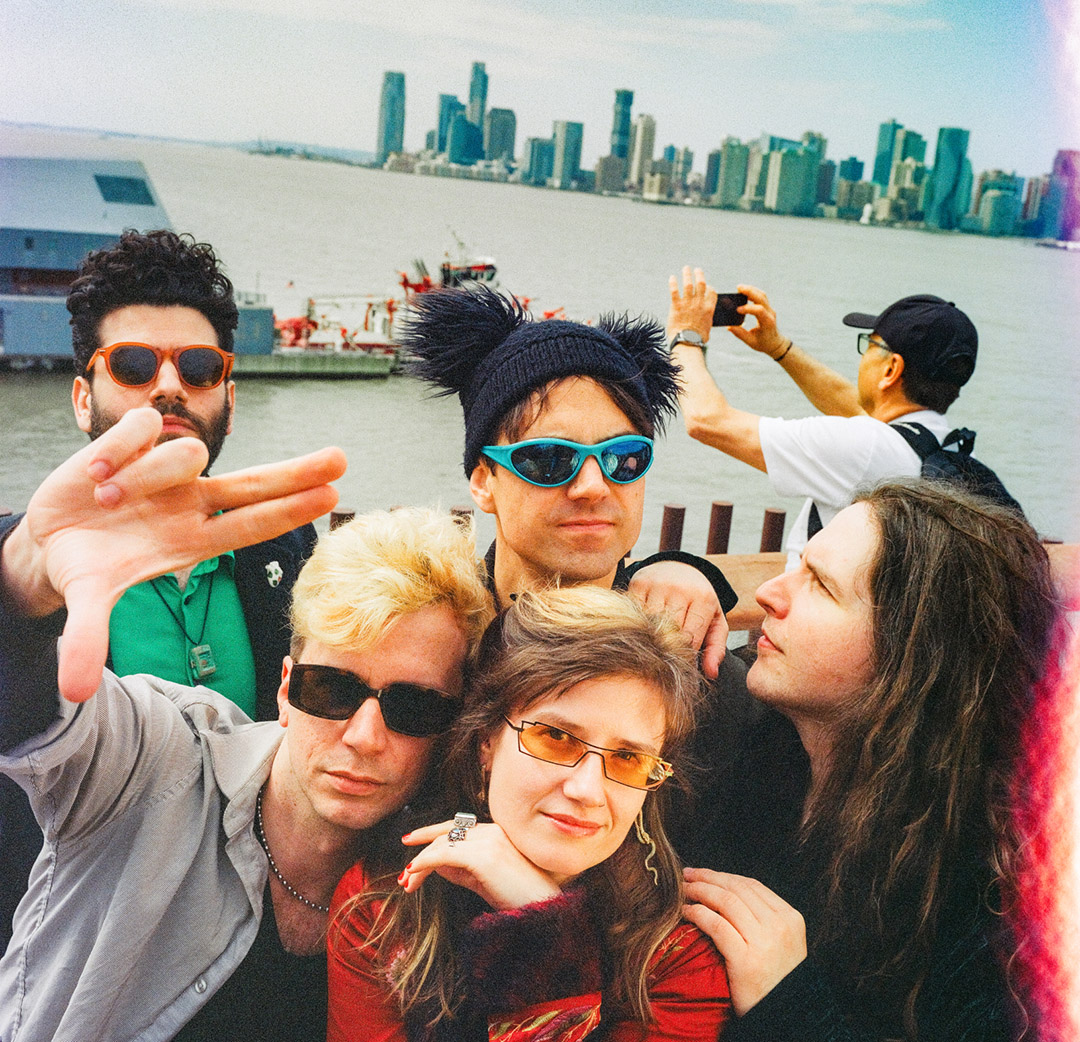
BODEGA Want to Make Rock Music Bigger, Stranger, and More Human Again.
For years, New York’s BODEGA have dissected the contradictions of modern life through sharp, politically charged post-punk. With their new album, All Inside Aquarium, they’re looking inward, embracing uncertainty, and rediscovering the power of a great rock song.
– WORDS BY CJ • PHOTOS BY Pooneh Ghana
Nikki Belfiglio remembers a show in 2014 when Ben Hozie interrupted an otherwise celebratory set to deliver a warning about consumerism. Something about the audience being slaves to McDonald’s, she recalls. “I never said that,” Hozie immediately protests. “You said it more poetically,” Belfiglio counters. The exchange is funny, particularly because the audience apparently seemed baffled by the sudden lecture. It also captures something about BODEGA, a band whose songs have spent years examining the strange conditions of contemporary life, even when the people listening might simply have wanted to dance.
Across Endless Scroll, Broken Equipment, and Our Brand Could Be Yr Life, the New York group developed what Hozie describes as a sociological trilogy. Technology, consumerism, identity, and the endless contradictions of modern culture provided a seemingly inexhaustible supply of material. Their fourth album, All Inside Aquarium, released earlier this month, represents a deliberate change. “We just took stock of where we’ve been,” Hozie explains. “Let’s try something else.” He doesn’t believe the band have repeated themselves particularly often, but admits that “you run the risk of just doing the same thing over and over again. Our favorite bands are always the ones that evolve.”
Belfiglio remembers feeling, a decade ago, that artists needed to address what smartphones were doing to people’s minds. “It may seem surprising now because it’s so encompassing, but people weren’t really talking about that within art,” she says. Now those concerns are almost unavoidable, and she no longer feels BODEGA need to keep making the argument. Their attention has shifted toward childhood memories and more personal questions. The band’s old political instincts haven’t vanished, but the impulse to explain what the world is doing to us has become an interest in what it means to live inside it.
The musical priorities have changed just as dramatically. “On the first two records, the lyrics always came first,” Hozie tells me. They weren’t the only thing that mattered, but he readily admits that the balance has flipped. “I actually put the riffing and the palette and the hooks and the melody itself” above the lyrics now, he says. For a band whose earlier recordings could feel like densely argued essays set to guitars, All Inside Aquarium makes a point of allowing the sound to carry its own meaning. The choruses are bigger, the melodies more immediate, and Hozie seems genuinely excited by the possibility of reaching people before they have unpacked every word.
“I actually think one of my biggest critiques of rock culture is that it’s become way too niche,” he says, comparing it to what happened to jazz. Too many musicians, he argues, make music primarily for other people who understand all the nuances of their particular subgenre. “I actually think it’s my hope and dream that rock actually becomes pop again.” He remembers when guitar bands shared commercial radio with Madonna and the Spice Girls, and sees no reason that kind of crossover should be impossible now. “Even so-called hip underground bands should try to write more and more pop songs,” he insists. “I feel like people are craving tunes again.”
Part of that ambition comes from the enormous, heavily layered sound of early-1990s alternative rock. Hozie has taken to calling the approach “Butch Vig-core,” especially when discussing the first two Smashing Pumpkins albums. “The philosophy of really overdubbing tons of fuzz guitars to create a huge kind of, frankly artificial, but massive, anthemic kind of pop-rock sound is kind of what we’re doing,” he explains. Previously, BODEGA’s two guitars might have been joined by a small additional part. This time, individual figures could be recorded four or five times through different amplifiers to achieve what he calls “the chunky sound that a lot of ’90s records have.” His enthusiasm for Gish, which he describes as “everything that’s cool in alt-rock music put into a blender,” is unmistakable.
To make the album, BODEGA traveled from New York to The Nave in Leeds, working with producer Matt Peel during sessions in winter and summer 2025. Belfiglio describes the experience as an extension of touring, with one important difference: they could stay still long enough to think only about the music. “There was something about not being able to go home to the home that you live in full-time,” she says. “You’re not in a comfort space technically.” She believes the unfamiliarity encouraged them to push harder, particularly when working with someone whose expertise differed from their own.
Peel’s ability to translate an emotional description into a sound became a crucial part of the process. “We’d be like, okay, we’re searching for this sound emotionally,” Belfiglio recalls. “And he’d be like, one second.” He would assemble an amplifier and an improbable number of pedals before asking whether he’d found it. She calls that ability to turn “the emotional language” into something physical “a really, really special skill.” Peel also encouraged the band to use keyboards more freely. “There’s a lot of organ, there’s a lot of synths,” Hozie explains. “They’re subtle, but they really pad out the sound.”
The change in sound accompanies a shift in Hozie’s philosophical outlook. On “Literary World,” the band examine the tendency to tell other people what to think while admitting the song itself may be guilty of precisely that. “I’ve embraced paradox more,” he says. Studying philosophy helped him through a chaotic period in his younger life, when the logical structures of Western thought offered a way to make sense of things. Now, however, he is drawn toward less conventional traditions. “I’m way more into more esoteric philosophies and things that embrace paradox, and, to be frank, more spiritual kind of worldviews.” For Hozie, spirituality means “being open more to mystery, the mysteries of existence.”
That openness runs through the title track, which considers personal responsibility and the possibility of finding peace without resolving every contradiction. Belfiglio extended the idea into the album artwork, spending months constructing a miniature world inside a fish tank before directing a video that places the band inside it. An equally revealing choice is their cover of Bob Dylan’s “Slow Train,” whose biblical conviction might seem at odds with the album’s uncertainty. Hozie disagrees. “The slow train coming around the bend can represent almost anything,” he says. “At times when I perform it, I’m thinking about climate change. Sometimes I’m thinking about the rise of conservatism. Sometimes I’m thinking about AI. Sometimes I’m literally thinking about the apocalypse.” The imagery has room for all of it.
BODEGA may want bigger songs, but Belfiglio has little interest in acquiring passive listeners. “We’re not looking for fans,” she says. “We’re not looking for subs or subscribers,” particularly people who never engage with the deeper meanings of the work. “We’re looking for people who want to see a growth or who want to feel a change,” she explains, and who will stay curious even when the music takes an unexpected direction.
Hozie has become frustrated with listeners who reduce BODEGA to one fixed political message. To him, that interpretation reveals more about the listener’s expectations than the band’s intentions.
Their complicated relationship with social media follows the same reasoning. “Real recognizes real,” Belfiglio says. She would rather use those platforms to tell interested people what the band is doing and share things that matter than devise strategies for clicks and views.
“I just think be real. Share your interests.” Hozie points out that their artistic lives extend beyond music: he makes films, Belfiglio creates visual art, and the band is only one part of what they do. “We’re gonna be doing it our whole lives, whether people care or not,” he says. “We’ve done it before they cared.”
When BODEGA made their early records, Hozie remembers thinking specifically about the people in Brooklyn who would hear them. “I don’t think I write that way anymore,” he says. “I write more strictly for the gods.” He wonders aloud whether that makes sense. I suggest he’s talking about serving the muse. “Exactly,” he replies.