Gotts Street Park Have a Hard Drive Full of Music We May Never Hear.
On their fourth album, Somewhere Between, the Leeds trio have become more confident in their songwriting, their collaborators and the sound they have spent years developing. Josh Crocker and Tom Henry talk about recordings that nearly disappeared, learning to trust the simplest ideas and a renewed sense of ambition.
– WORDS BY CJ
Somewhere on a hard drive belonging to Gotts Street Park, there are songs that Josh Crocker suspects might be among the best things he has ever made. Plenty will probably never be released. “Most of the music we make just sits on a hard drive for years,” he says. “And probably some of my best music will never be heard.” One recording that narrowly escaped that fate is “Easy,” a collaboration with Celeste dating back to some of the first sessions the Leeds musicians held with her, almost a decade ago. They had always liked the song, but somehow it never found the right home. When they started pulling together Somewhere Between, the trio’s fourth album, they realized it might finally have one. “We’ve been sitting on that song for years and years, and never really found an opportunity or the right time to put it out,” Crocker explains. They did little more than revisit the mix, and a recording from a very different period of their lives took its place alongside the new material. “I’m just glad that we managed to get that one out.”
Three years have passed since On the Inside, but Gotts Street Park were making music together long before that album, releasing Volume One in 2017 and Volume Two in 2020. Those earlier recordings capture musicians discovering the possibilities of their own sound, and Crocker remembers how On the Inside gradually found its audience through people recommending it to one another. “It was a slow, organic kind of momentum that it picked up really,” he says. He expects Somewhere Between might follow a similar course. “A lot of it’s just kind of out of our control to a certain extent,” he says. “It’s nice to feel like it’s finished and it’s out there, and then it’s just, yeah, whatever happens, let it do its thing.”
The recording process was considerably different this time. Much of the group’s previous work had been made in Crocker’s home studios, including a basement in Leeds. After the pandemic, he moved to York with his family, while Tom Henry and Joe Harris remained in Leeds. For a period the trio no longer had a shared place to record. Instead, they booked studios across Leeds and London, working in concentrated stretches with different engineers and equipment. “It was quite a big departure for us in a way,” Crocker says, describing the experience of doing familiar things in “completely different environments.” Those rooms brought new instruments and microphones into play, while London made it easier for visiting singers to join sessions. The change of setting found its way into the recordings.
Their listening habits were changing too. Jessica Pratt was a particular favorite of Crocker’s, while Big Thief and Blaze Foley were among the artists circulating around the group. Parts of Somewhere Between, including the songs featuring Matt Maltese and Sofia & The Antoinettes, lean toward seventies songwriting, with more room for the voice and melody. Crocker is reluctant to describe that as a deliberate change in direction. “Nothing’s premeditated too much,” he explains. “It’s not like we get into a room and go, ‘Right, let’s try and make an early seventies type of song.’” The musicians bring whatever they have been listening to into the studio, sometimes without recognizing its influence until later. “It’s a constantly evolving thing, like what we’re all listening to, what we’re influenced by.” The results still sound recognizably like Gotts Street Park.
Some of the album’s arrangements were shaped by fairly practical considerations. Henry points to “Nico’s Theme” and “Going Home,” two instrumentals written later in the process when the band realized they wanted more energy in both the album and their live performances. “We find the slow kind of chilled stuff comes quite naturally,” he explains, whereas making something more upbeat requires a conscious effort. “Obviously it’s nice to play some upbeat stuff for the crowd,” he adds, describing the opportunity to dig into their instruments and let loose a little. “There was a feeling of like, ‘Oh, it’d be nice to have some more energetic instrumentals for the live set as well.’” The contrast with “Flowers,” featuring Pip Millett, is revealing. Henry remembers that song originating from sessions that had initially been intended for Millett’s own work, before the band had properly begun planning the album. “There was no, ‘Let’s write for the album,’” he says. “It was just to kind of get together and see what happened.” The more purposeful late sessions and those earlier, open-ended experiments have ended up sharing the same record.
Working repeatedly with singers has taught the band how different a productive session can look depending on who is in the room. Celeste might step up to a microphone and immediately find a song. “Anything will just come out, and often that is like the song,” Crocker says. Pip Millett works with a notebook until she has developed her lyrics, then gets on the microphone to reveal them. Rosie Lowe prefers taking sketches away and working privately, concentrating on the minute details of her vocals in her own time. “Learning how they all have different methods to get there is definitely useful,” Crocker says. “Sometimes you might get in with someone and kind of force an approach on them that they may feel really uncomfortable with.” Usually one of the musicians already knows the singer before a session, and returning to familiar collaborators means everybody understands more about how the others work.
Henry remembers the pressure that accompanies a studio session, when everybody feels they ought to have something finished before leaving. “It’s nice to realize it doesn’t always have to work that way,” he says. Crocker is similarly wary of judging an idea too early, before anybody knows what it might become. “It’s judgment as well, isn’t it? Like trying to hold back judging something before it’s fully formed.” The trio have learned to resist placing a song into a familiar category the moment it begins to emerge. Henry thinks they have become better at this because they no longer worry about running out of ideas. “There’s no feeling of preciousness about what it needs to be,” he says. “It’s just allowing it to be what it is.”
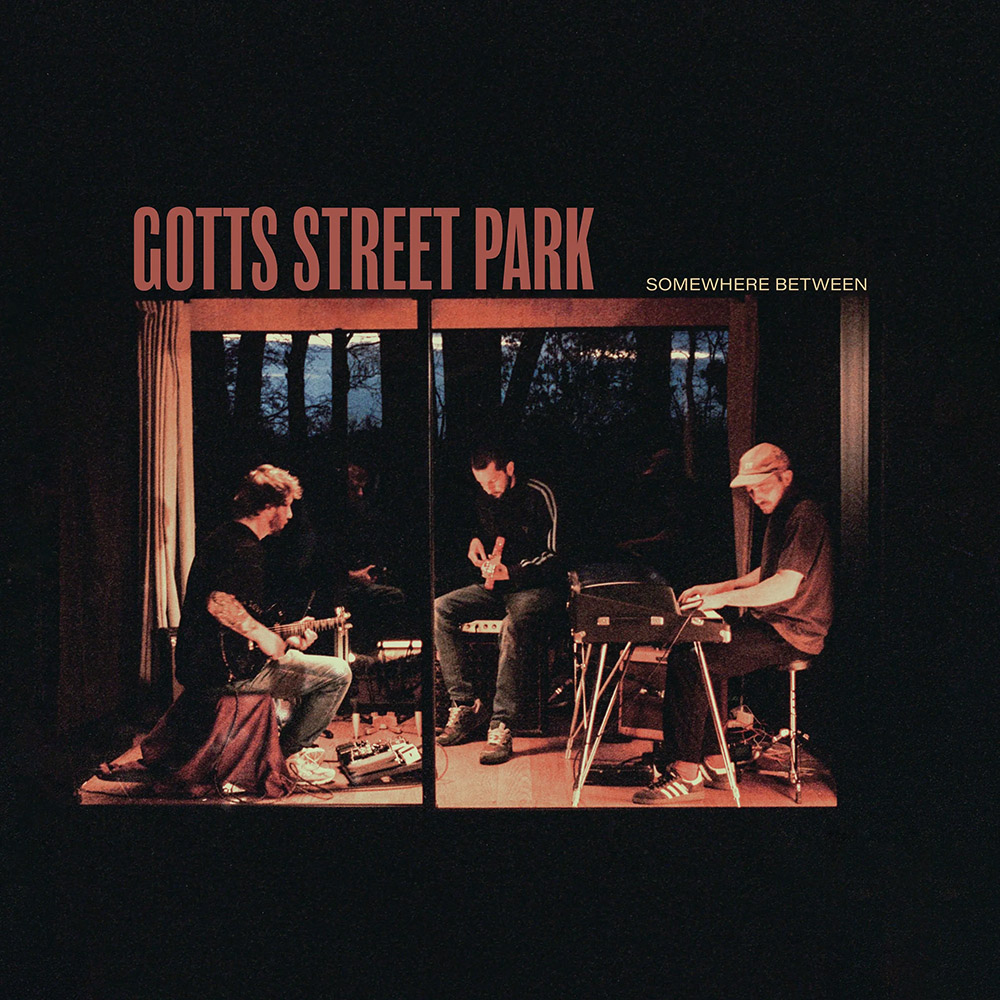
Somewhere Between released 10/16/2026
That willingness to leave things alone extends to the arrangements themselves. Henry remembers how much of the excitement in the early days came after the band had finished playing, when Crocker would begin working on the recordings.
“Josh was probably predominantly the one creating the production magic,” he recalls, particularly the drum sounds that could transform something quite straightforward in the room. The others gradually learned to imagine those possibilities while they were still writing. A basic groove could become the foundation of an entire track because they understood how it would sound once recorded. “We have a sound, and that sound is that we can just be really simple and it can still sound very cool with very few elements,” Henry explains. “The parts don’t have to be complicated. They can be very simple and very complementary to each other.” The approach now influences what he plays, and it has given the musicians greater confidence in arrangements that might once have seemed too spare or unfinished.
Crocker thinks recognizing their own sound has made them more adventurous. They can “work with totally different artists, and have very different kind of songs,” trusting the common thread created by the three musicians and their guests. Previously, they might have worried that a track was too different to belong on an album. Finishing the music is another challenge. “I always feel tempted to just constantly keep tweaking and making things better,” Crocker admits, adding that mixing can continue almost indefinitely. With Somewhere Between completed months before its release, he eventually had to stop. “It’s nice to just be like, ‘This is it. This is finished, and now it’s out and people can enjoy it.’”
The band have begun performing in America and are preparing for their biggest headline show yet. Those developments have changed how Henry thinks about their future. “I would say there’s a renewed sense of ambition,” he admits. “I feel more enthusiastic about pushing it and taking it seriously in terms of a business.” Gotts Street Park has long existed alongside his production work and music for advertising, which he assumed would remain the more reliable source of income. He is realistic about the money the band currently makes, but touring, releasing another album and seeing an audience grow have raised his expectations. “Probably the most hopeful I’ve felt about it doing well,” he says, while acknowledging the difficult balance between wanting a band to succeed and depending on that success for personal validation.
Crocker mentions a video comparing releasing music in 2026 to pouring a cup of water into the ocean. With so much arriving every day, he wonders whether more listeners might return to spending time with an album from beginning to end. “I feel like there’s some value in just making a good album that flows properly as an album for people that like to buy vinyl,” he says. He is skeptical of the industry’s obsession with viral success, too. “It doesn’t give you fans, it doesn’t sell merch,” he says of attention that never becomes a lasting relationship with an audience. Gotts Street Park have spent years building those relationships through records people recommend to one another. On November 25, they will take Somewhere Between to the Roundhouse in Camden, with the more energetic instrumentals written partly to give them room to stretch out onstage.