Brody Price Is Building a Life He Can Stand Behind.
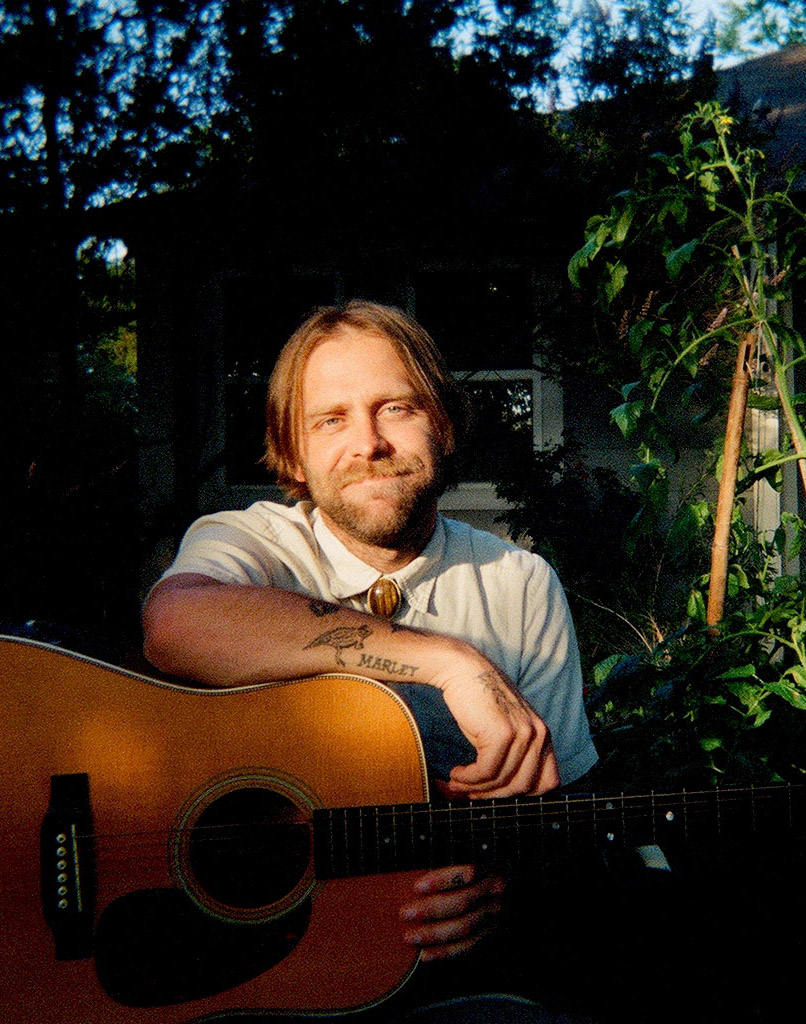
Brody Price spends a lot of time in the garden. Not as an escape from making music, exactly, because almost everything in his life seems to eventually find its way back toward making something.
– WORDS BY CJ • PHOTOS COURTESY OF BRODY PRICE
He writes songs, makes physical art, tours, plays in other people’s bands, and tends plants at his home in Oak Cliff, where the garden became an unofficial second room during the making of Leaf Miner’s Daughter.
He would work on a song, go outside, move around among the plants, let a lyric or melody keep running somewhere in the background, then return to it later. The record grew through those repetitions, which makes its title feel less like an eccentric piece of imagery than something he found waiting for him in the dirt.
A leaf miner is a tiny insect whose larvae live inside leaves, feeding their way through the tissue and leaving pale, wandering trails behind them. The damage can look strangely beautiful until you remember what is producing it. Price had plenty of time to think about that while he was making a record that he describes, without much hesitation, as intense.
“I was just getting pummeled with anxiety and all these things,” he says. “The inevitable destruction and anxiety that comes with this totally natural part of the ecosystem kind of felt like a way that was reflective of that season of life.”
There isn’t much a gardener can do once the process starts. You can pay attention, try to protect what is growing, accept that some damage has already happened. Price recognized something in that helplessness. Leaf Miner’s Daughter was written near the end of several difficult years in which, as he puts it, the walls were beginning to cave in. His drinking had become increasingly destructive. Relationships, habits and older versions of himself were becoming harder to maintain. He got sober a little over a year before our conversation, and only afterwards was he able to look back at the songs as a complete object and recognize how much of that period had made its way into them.
At the time, he wasn’t designing an album about collapse and recovery. He was writing because he needed somewhere for the experience to go.
Price is suspicious of arriving at a song with too much information already decided, whether that means theme, genre or the precise meaning a listener is supposed to take away. There is a line on the record, “things fall apart and I keep them around”, that can carry objects, relationships, memories or previous selves without having to choose between them. Price writes from circumstances that may be painfully specific to him, then begins removing whatever prevents somebody else from entering.
“I try to leave enough space to where I’m kind of siphoning out,” he says. “The only thing that passes through the filter in the process of making a song are the things that are gonna be relatable and universal.”
That openness does not make the music vague. Quite the opposite. Price’s songs can move from country to folk to abrasive rock without asking permission from the borders between them, though he finds the idea that he is consciously choosing those genres slightly strange. He talks about songs as though they arrive with at least part of their identity already intact and his responsibility is to notice them properly.
“When a song introduces itself to me in whatever way, it feels more so like they’re already there,” he says. “It’s my job to, as little bits and pieces come in, do my best to render what that song is.”
Price takes that idea further than metaphor. He describes some underlying force that produces people, spirit, art and eventually songs, all of it “bubbling up to the surface” in forms that already exist before the artist gets involved. His job is to field the pieces as they appear and assemble them without interfering too much.
“Kind of stare into the void and render whatever it is that I see.”
What comes through Price’s own lens will inevitably carry country music with it. That is where his instincts were formed, even when the finished track becomes too heavy, strange or structurally wayward to fit comfortably beneath the label. To him, they are country songs regardless. Country is less a set of approved sounds than a way of understanding the material.
The sequencing of Leaf Miner’s Daughter accidentally makes some of its internal logic particularly visible. “Atrophy” arrives early; “Beginnings” appears much later. Price didn’t consciously build a narrative between them, but once the record was finished he could see why those words belonged in the same collection. Things had been falling apart. Sobriety required admitting that some of them could not be kept alive.
For years, he says, he had been trying to stave off those smaller deaths “ineffectively.”
Getting sober gave Price another way to understand attention. He is a devoted Grateful Dead fan and talks about following the band with the seriousness of someone describing an education rather than entertainment. Dead shows, perhaps more than most concerts, reward listeners for actually participating in what is happening. Stand around waiting for the obvious bit and the whole thing can sound like three hours of tuning. Listen actively and the same performance begins opening doors.
“The more you put in and engage with it, the more you’re gonna get out.”
Since getting sober, Price has noticed that principle operating everywhere. Watching friends’ bands feels different. He pays attention through the whole set. There is no drink to locate, no secondary activity competing with what is happening in front of him. Music becomes the event rather than the soundtrack to whatever else the evening is doing.
“I’m actually appreciating what I’m seeing in real time,” he says, “which is a new thing.”
It is also a useful instruction for Leaf Miner’s Daughter, a record Price has no interest in pretending is for everybody. The structures are strange. The music can be abrasive and physically heavy. Moments of release matter because they have been made to coexist with long stretches of pressure, and pulling one section out for a fifteen-second introduction misunderstands why it is there.
“I don’t think it’s a record for folks that are wanting to casually listen to music,” he says.
Price would prefer headphones. Better still, see the songs live. The album was sequenced to feel like occupying the same room as the band, moving through a complete show rather than being offered a row of interchangeable tracks. It takes up space and expects the listener to make some in return.
“If that’s not for you, that’s cool.” He means it. Price seems almost reassured by the knowledge that plenty of people will leave the record behind. “I’m very, very pleased that it will probably be left behind by a lot of people because it’s not for them. I didn’t make it for them.”
That certainty has taken time. Like many people who began making music young, Price once had to negotiate the larger fantasy sitting behind the work: breakthrough, momentum, somebody eventually arriving to move things onto another level. At 34, he is still ambitious, but the shape of that ambition has changed. He has watched friends from the DIY communities around him have their moment above the surface. Some have gone further than others. What matters increasingly is how to keep making the next thing after whatever happens.
Price remembers visiting the Picasso Museum in Barcelona and being struck not by a single masterpiece but by accumulation. Picasso was represented by the sheer evidence of having spent a life making work. One painting did not explain him. Thousands of decisions did. Price wants something similar from his own life, not in stature but in structure. “At the end of my life, having my life be able to stand on its own as a work of art.”
It changes the practical question from How do I make it? to How do I continue? How do you fund another record, play another tour, make something after that, and do it without waiting for a benefactor to authorize your existence as an artist?
“If I’m doing it by myself, that’s great. I’ll keep doing it that way. If someone else wants to come along and help, that’s cool too.”
Price looks at friends with more money, children and lives built around entirely different priorities and does not sound defensive about the comparison. Those lives make sense according to their values. His makes sense according to his.
“I’m stoked to just get to make art.” By his definition, the success of an album ends almost absurdly early: when the masters come back. Everything after that is distribution, response, circumstance. The work has already met the standard he can actually control.
What remains is community. Price has spent years touring through DIY spaces, meeting people who became close friends despite living all over the country, and his idea of artistic ambition now includes responsibility to those people. Being part of a scene is passive. Deciding what role you play within it is something else. “How are you gonna take care of your family within this community?”
He talks about another artist’s success as something shared. If somebody from the group gets further, finds a bigger audience or catches an opportunity, there is room to understand the victory collectively rather than treating every neighboring musician as competition.
That may be the most revealing connection back to the garden. Leaf Miner’s Daughter was made while Price watched damage spread through plants he was trying to keep alive, during a period when parts of his own life were coming apart faster than he could preserve them. He has emerged from that period less interested in permanence than continuation. Plants get eaten. Bands disappear. People change. Records are finished and immediately stop belonging entirely to the person who made them.
You make the next thing anyway. For Price, that remains the whole point.