Darksoft Finds a Way Out of the Everyday.
There is a particular kind of joke hidden inside calling an album Everydayness. It sounds like something designed to disappear into the background, the name of an idea too ordinary to need examining. In Darksoft’s case, it apparently began even more literally than that: Bill spotted the word on a shampoo bottle in his shower.
– WORDS BY CJ • PHOTOS COURTESY OF DARKSOFT
Its ten songs are preoccupied with the things we repeat without thinking about them: habits, routines, phrases worn smooth from use, the tiny pieces of language and behavior that accumulate until they begin to resemble a life.
For much of his life, repetition had meant the opposite. Bill talks about growing up with a cultural understanding of routine as something faintly depressing, the Office Space version of adulthood in which each day resembles the previous one and the joke is that nobody quite knows how they ended up there. “Everydayness had a negative connotation to me,” he says. But repetition changes character when you choose it. Do something deliberately every day and the same mechanism that can make life feel monotonous can also slowly build a record, a body of work, a skill. “If you’re doing something intentionally and doing it every day, then you can create something great over an extended time period.”
Bill is unusually comfortable admitting that he does not always understand an idea completely before committing it to a record. When we talk about where useful repetition stops and monotony begins, there is no polished thesis waiting. “I don’t know,” he says after thinking about it. “Let’s keep talking. Maybe we’ll get somewhere.”
Darksoft’s albums can look highly conceptual from the outside — Grayscale, Relativism, Rationalism, now Everydayness — but they do not arrive as finished arguments. They are closer to working documents, records of somebody using songwriting to prod at an idea until its edges begin to appear. “I’m often writing what I think I need to hear in the moment,” he says, “maybe to cope with my surroundings or cope with the world at large.”
The same method appears in the language. Bill has spent several records pulling phrases from the enormous communal pile of things people say without really hearing themselves say them: “it is what it is,” “same old, same old,” “rinse and repeat,” “no news is good news.” The phrases are almost anti-lyrics. They have passed through so many mouths that their original meanings have been sanded away. He began using them partly because he liked that emptiness. Early in the project, shoegaze offered a model for treating the voice less as a narrator standing in front of the music and more as another texture inside it. What if the words behaved similarly?
Something unexpected happened once Bill started living with those clichés. The supposedly meaningless language began acquiring meaning again. “Eventually I found I was rewiring myself or reassigning meaning to the phrases,” he says. He mentions writing “It Is What It Is” precisely because he hates the expression. Instead of throwing the phrase away, the song forced him to sit with it long enough to ask what it was actually trying to communicate. These fragments of inherited language became less like lazy shorthand and more like artifacts from a collective consciousness.
There is also a deliberate absence at the center of these songs. Bill writes the lyrics, plays the instruments, records the parts and constructs much of the world himself, but he is wary of making Darksoft entirely about himself. “There’s so much of me in this,” he says.
Lyrically, he tries to move backward rather than forward, leaving enough empty space that another person can climb inside. In a period when music is frequently sold through exhaustive autobiography, that refusal to completely explain himself feels almost strange. The songs offer something more anonymous: common phrases, common routines, recognizable structures. You can listen closely or you can allow them to surround you.
That flexibility is central to how Bill thinks about the music itself. He wants Darksoft records to survive two apparently contradictory kinds of listening. They can sit in the room while you work, the repeating guitars and softened vocals creating an atmosphere without continually demanding your attention. But if you turn toward them, there are songs underneath: verses, choruses, melodies, deliberate lyrical ideas. He calls it “walking that fence.” The distinction is useful because the current revival of shoegaze and dream pop has occasionally confused the sonic vocabulary of those genres with the songwriting that made their best records endure.
Bill works in the opposite direction. He prefers to begin dry, to make sure the composition survives before the scenery arrives. “They wrote the songs and then they put the effects on top of them,” he says when we talk about the Cocteau Twins. “A lot of people start with effects.” His own process begins with the skeletal thing: guitar, lyric, structure, something that works before the reverb turns it into a place. The more immersive qualities come later, increasingly through his collaboration with mixing and mastering engineer Brian Fisher, who helps reamp parts and construct the finished environment around the song.
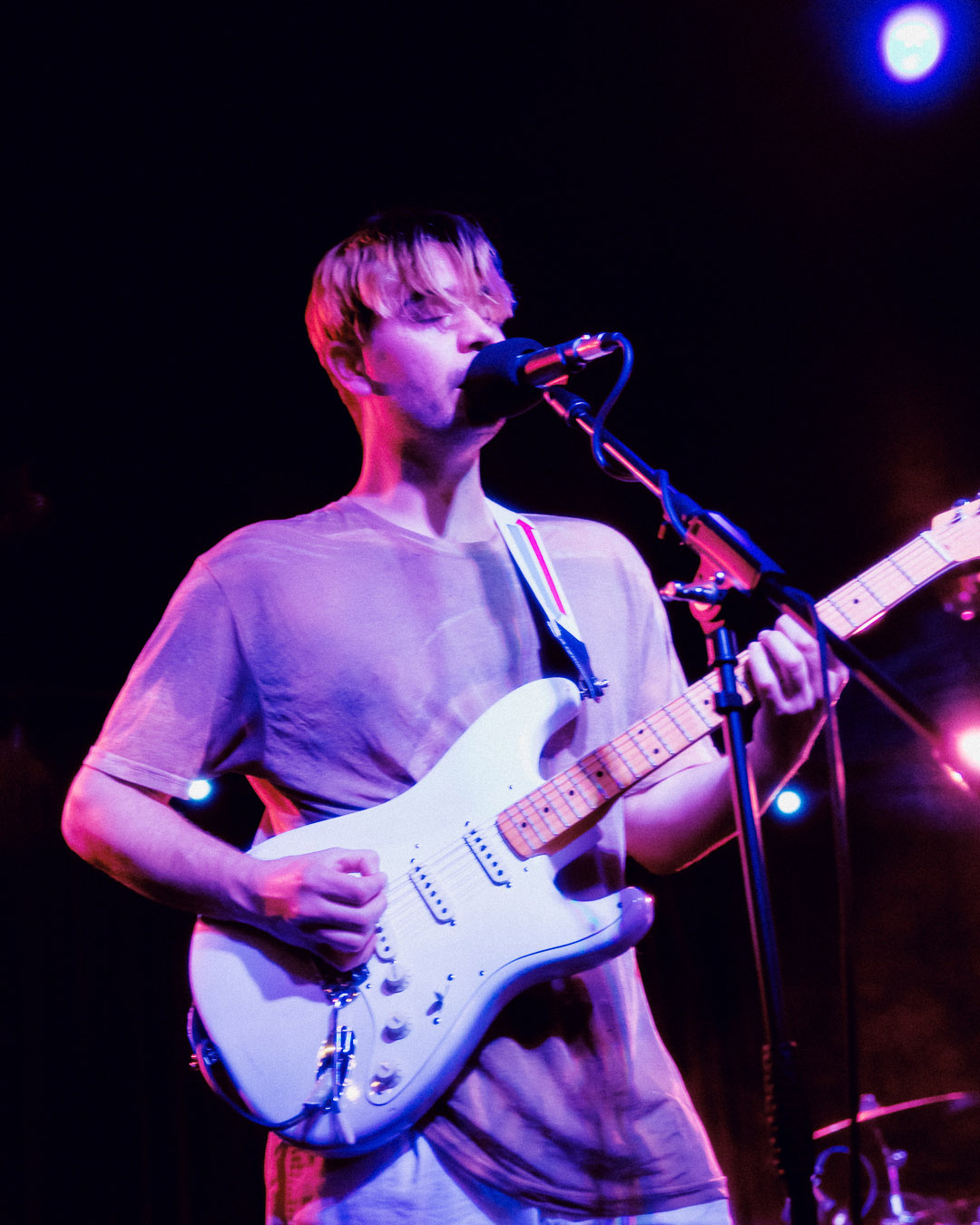
For an artist making music capable of feeling almost weightless, Bill is surprisingly committed to physical things. Darksoft began in 2018 with lyrics written on paper and an acoustic guitar. He still wants real instruments played by hand.
Even synthesizer parts largely come from outboard hardware rather than being assembled inside a computer. That approach has taken on new significance as generative AI has made instantaneous music production possible. Bill does not frame his response as some grand rejection of technology; he simply finds himself increasingly interested in evidence of the act itself — a hand playing a guitar, a synthesizer physically recorded, a performance existing because somebody had to sit there long enough to make it happen.
“The actual act of producing and recording,” he says, has become part of what an artist can offer. If the finished object can be generated almost instantly, then perhaps the process becomes newly visible. Bill’s answer is to move further outward: more outboard equipment, more physical recording, more imperfections created by objects passing sound between one another.
Perhaps that is why the word “otherworldliness” catches him when it comes up in our conversation. He stops and writes it down. It seems initially like the opposite of Everydayness, but the two ideas belong together more neatly than that.
Repetitive guitar music can alter the shape of an ordinary room without asking you to leave it. A repeated drum pattern can occupy enough of your attention to quiet everything else. A song can become background music and somehow make you concentrate harder. The routine itself becomes the escape route.
Darksoft’s next project may make that relationship explicit. Its working title is Ultra View, inspired by the overview effect astronauts describe after seeing Earth from space. If Everydayness places its attention on the repeated actions directly in front of us, the next record intends to move the camera considerably farther away. “It’s kind of taking, like, leaving the everydayness and taking more of a big-picture look,” Bill says. “It’s good to take a step back sometimes.”
That may be the useful thing about the sequence he has been building since 2018. The albums do not resolve the questions they introduce so much as create another angle from which to ask them. Everydayness takes things that normally disappear through familiarity and stares at them long enough for them to become peculiar again. A cliché becomes a lyric. A routine becomes a method. A word on a shampoo bottle becomes the organizing principle for a record.
You repeat something until it becomes ordinary. Then, sometimes, you repeat it a little longer and discover it was strange all along.