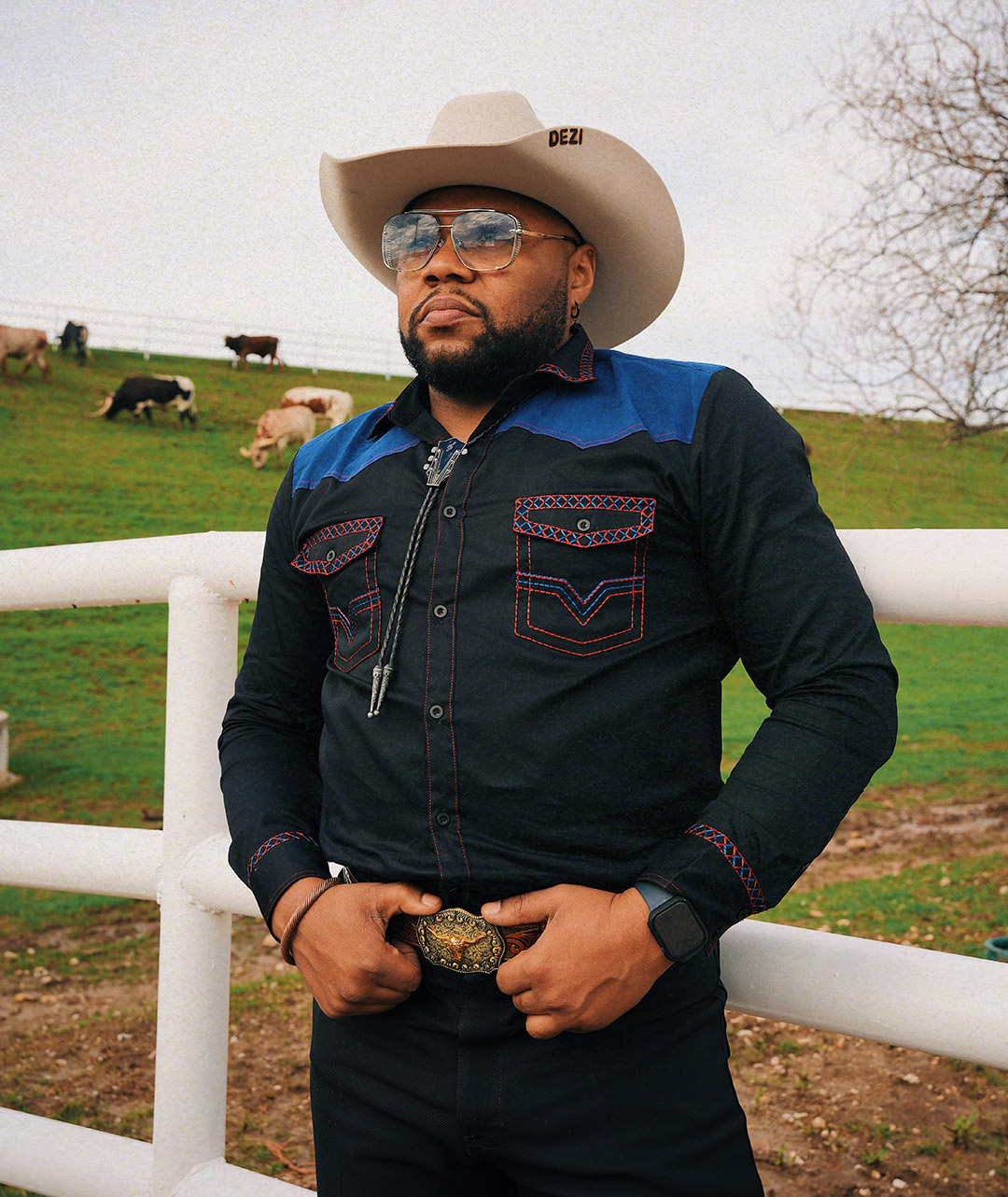
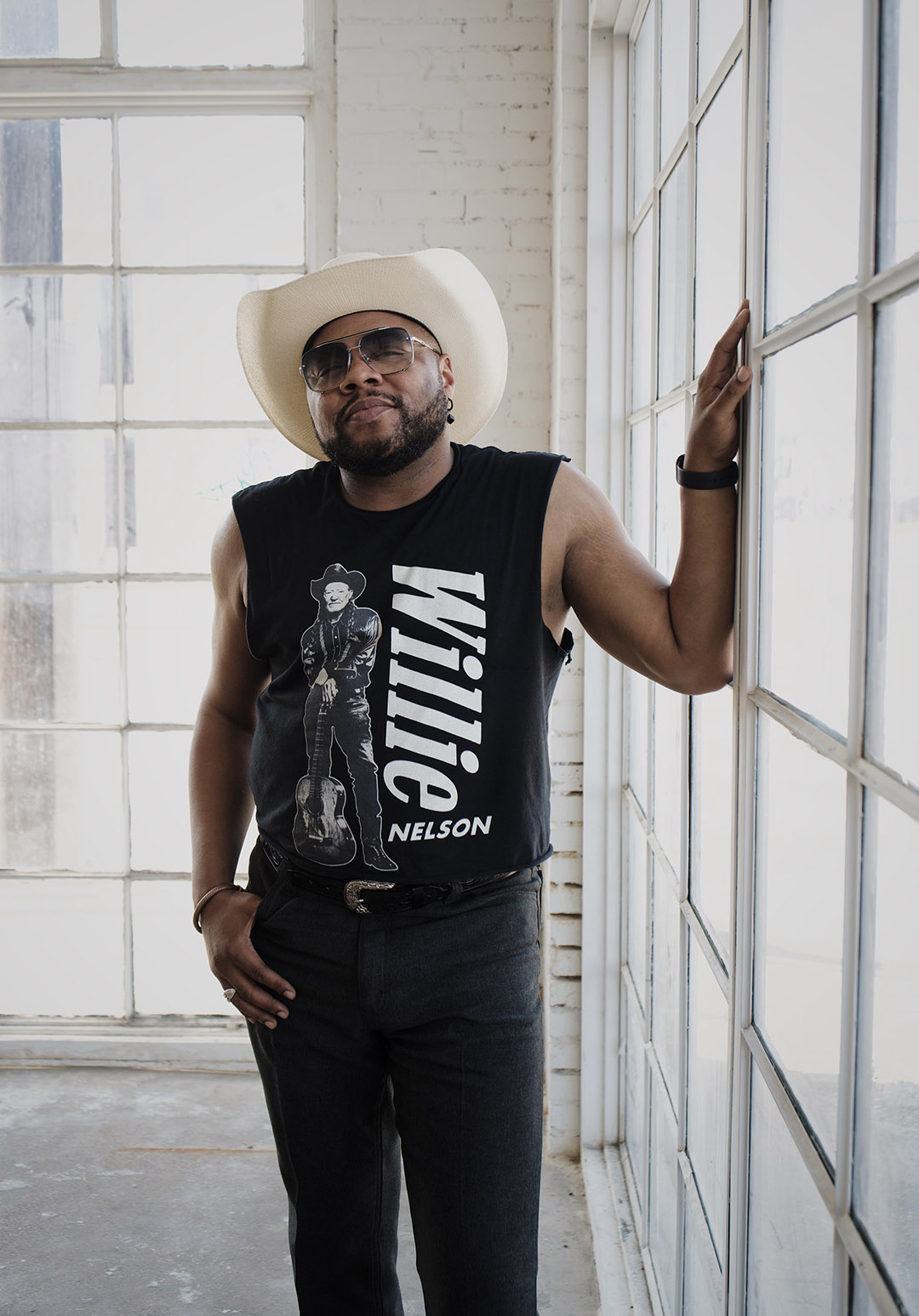
Dezi 5 Brings Soul, Personality and Texas Pride Together.
For a while, “T-E-X-A-S” was something Dezi 5 had on his phone. He was playing a residency at the Virgin Hotel in Dallas when his band landed on The Temptations’ “My Girl,” and he began making up lyrics over the bass line. He asked the bassist to keep playing, let the idea run and, fortunately, happened to be recording.
– WORDS BY CJ • PHOTOS COURTESY OF DEZI 5
It could easily have remained one of those little moments that happen during a show and disappear by the next morning. Instead, when he finally had the funding to make a new record, he remembered exactly where to find it.
That freestyle has become the lead single from Texas Soul, a four-song introduction to the sound Dezi has spent years trying to get onto record. Its Stevie Ray Vaughan influence is quite deliberate, but the song’s origins say almost as much about the project as the blues guitar does. Dezi has been thinking about the stage even when he is in the studio, and about how the people playing beside him can make a song feel as immediate on record as it does in the room.
His previous album, Dirty Laundry, had taken another approach. Inspired heavily by contemporary R&B, he built the recordings from layers of instruments, vocal tracks and background harmonies. He enjoyed making it, but performing those songs exposed a problem: the sound he had created was difficult to reproduce with the band standing in front of an audience. By his reckoning, he would have needed at least eleven people to play the record as it was made. This time there are six, Dezi included, and he wants what you hear through headphones to be what you hear when they take the stage.
“I promised myself that my next record would be as minimal as possible,” he explains. “What you hear on the recording is what you’re going to experience onstage.” The practical savings are not lost on him, either. “And let’s be real, it’s a little easier on the pockets, too!”
But the decision is about much more than personnel. Dezi is a singer with a formidable, naturally gritty voice, and he knows exactly how much of it was disappearing into the production on earlier recordings. He speaks about this album with the satisfaction of somebody who has finally stopped having to sing around his own arrangements. There is no Auto-Tune, he says, and no desire to smooth away the rougher edges that make his performances recognizable. The point was to record the voice people already knew from his shows, rather than construct a more polished alternative.
“Nothing has complemented my voice quite like this record does,” he says. “You can hear all those musical influences, but you can’t replicate my voice. That’s what makes it Dezi 5.”
He calls the music Texas Soul, a description wide enough to accommodate the country, rock, blues and soul that have always occupied space in his life. The name might sound like a newly devised genre, but the ingredients go back to his childhood in Dallas. His grandparents were enormous Dolly Parton fans; Hee Haw was regular viewing, and country records were played alongside everything else he was hearing. He remembers Randy Travis, Willie Nelson and Dolly, then the arrival in the 1990s of artists such as Tim McGraw, George Strait, Shania Twain and Reba McEntire. His mother loved Dolly and Reba too, and the Christmas specials were part of the family calendar.
The country element became harder to ignore when his mother heard him sing one of the songs on Dirty Laundry with a little twang. She told him he ought to make a country record. He laughs about it now, but he listened. What has followed is not a straight conversion to country music so much as the decision to stop treating it as a separate influence, something he could draw upon occasionally without allowing it into the center of his songwriting.
The four tracks on Texas Soul, released October 2, each approach that decision differently. “T-E-X-A-S” carries the blues in its guitar playing and swagger; “Mí Familia Texicana” brings in the Tejano music, accordion and Latin percussion he loves. “Short End of the Stick” is a ballad for people who feel life has dealt them a difficult hand, while “Paint the Town” was already a song in his repertoire before he revisited it, removing the background vocals and adding pedal steel until it sat more naturally alongside the new material. They are different expressions of the same singer rather than four attempts to demonstrate a narrowly defined genre.
He is careful not to give away everything. A full-length record is due in March, and he promises plenty more songs with the energy of “T-E-X-A-S.” In the meantime, the EP offers a useful glimpse of what happens when Dezi’s various musical histories are no longer kept apart. He also has another name for what he is doing: Funky Tonk. Where Texas Soul describes the music itself, Funky Tonk is his description of the occasion, especially as he prepares to take this band into rooms more commonly associated with country acts.
“When you see my flyers, you’re never gonna see the word honky-tonk, because I ain’t no honky!” he says. “We’re gonna make all these tonks funky!”
The humor is typical of Dezi, but behind it is a fairly exact idea of how his concerts ought to operate. He talks about Bob Seger and Billy Joel as models for the size of feeling he wants to produce, not because he intends to imitate their recordings but because of the confidence with which they command a stage.
He wants to move more, put more of his personality into the performance and trust that the arrangements will hold together without needing another five people to make them sound complete. He has been paying close attention to the response he gets when singing other people’s songs, trying to understand how to carry that same energy into his own.
It has also made him increasingly particular about who stands beside him. Dezi 5 & The Tailgaters is not simply a convenient name attached to whichever musicians happen to be available. He speaks about the group as a set of relationships that have taken time to establish, with commitment and honesty just as important as musical ability. There are gigs he would consider turning down if a member couldn’t play, rather than send out a substitute and hope nobody noticed. He wants the audience to encounter the band whose collective sound he has put on the record.
This investment in the people around him also extends beyond his own performances. Dezi is preparing the fourth Dallas Entertainment Awards, an undertaking that has become another significant part of his working life. Nominations are due to run from November 1 through December 31, followed by the announcement on January 7, a meet-and-greet showcase on January 24 and the ceremony at The Bomb Factory on February 3. He talks about the growth of the awards with obvious pride, and about the enormous range of people who contribute to the city’s entertainment community. For somebody so focused on making his own music more personal, he seems equally determined to give other performers an occasion on which to be seen.
Before all of that, there is a more immediate test. On October 16, Dezi 5 & The Tailgaters are scheduled to play the State Fair of Texas, a particularly appropriate setting in which to introduce a project that takes such delight in its Texas identity. The songs were designed to survive the journey from studio to stage, and now they get to make it. Dezi no longer needs eleven people to recreate what he recorded, or a heavily processed vocal to sound like the singer he wants to be. The six musicians who made this music can simply walk out and play it.