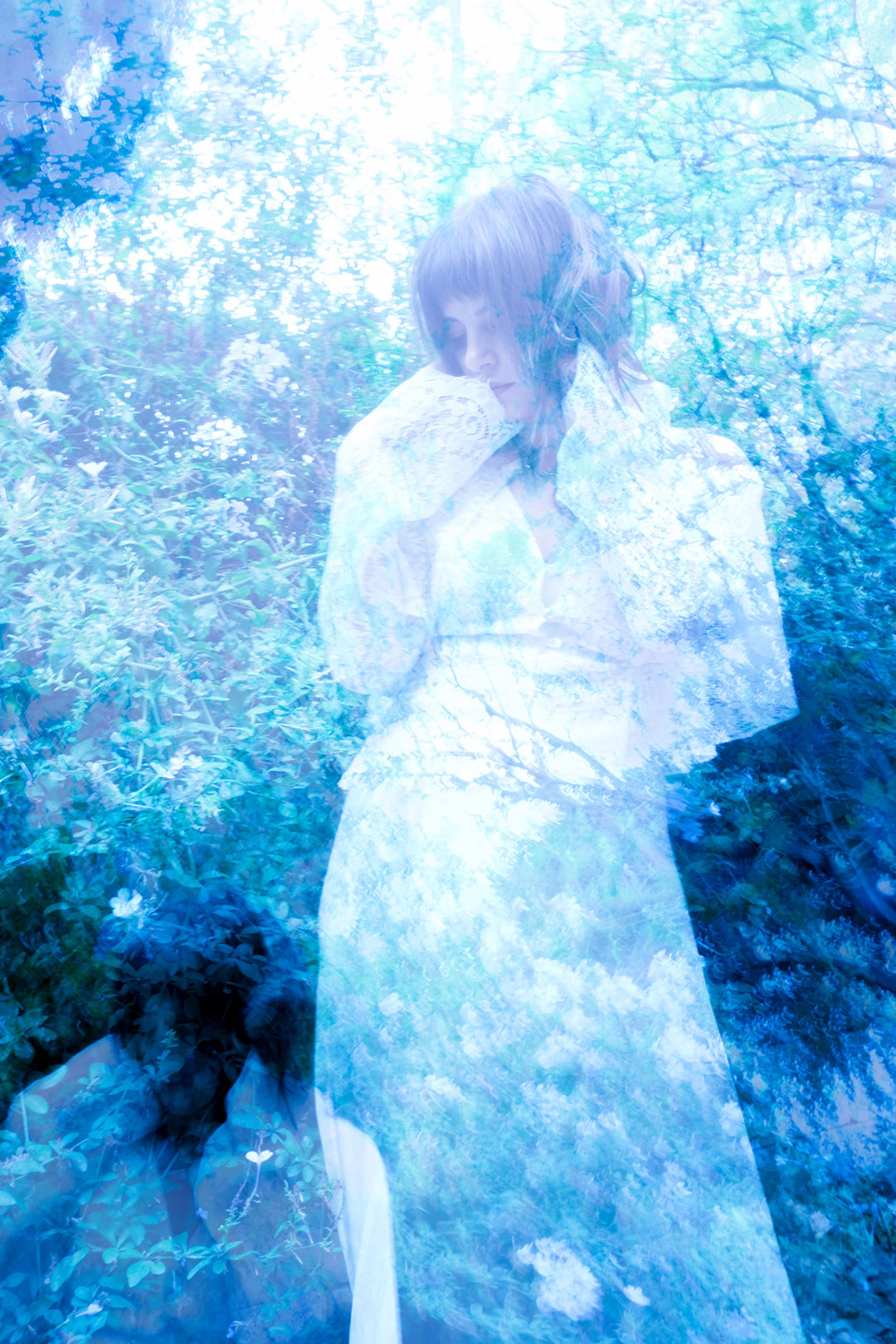
Dream Crease Makes Music for Places That Don’t Exist.
Every night, Marina Aguerre goes somewhere. The locations repeat often enough that they have acquired their own weather, their own light, perhaps even their own physics: a sky so dark blue it feels almost solid, thick air holding tiny glittering particles that shift as somebody moves through them, landscapes dominated by plants, water and whatever strange logic makes a place recognizable despite the fact that it has never existed anywhere outside a sleeping mind.
– WORDS BY CJ • PHOTOS BY PRISCILLA MARS
The frustrating part is that these places arrive with extraordinary clarity and disappear without leaving anything as useful as a photograph. Painting would solve the problem, theoretically. “I wish I could paint them,” Aguerre says, before adding with a laugh, “but I’m bad at painting.”
So she makes records instead.
Dream Crease, Aguerre’s fantasy-ambient solo project, begins surprisingly often with location. Not location in the ordinary sense of standing somewhere and attempting to describe the scenery, but the harder task of rebuilding how somewhere felt once the physical evidence has disappeared. A synth might become the atmosphere hanging above everything; an arpeggio establishes the ground beneath it. Sometimes the listener is moving through the landscape, which means the song has to behave like a journey. On others, the world is the moving part and Aguerre simply places you somewhere inside it, stationary while everything passes around you.
“The common thread between all the locations is the atmosphere,” she explains. “The sky is a deep deep blue; the air is thick, heavy, and rich, and floating within it are glittering particles that move as you pass them.”
It would be easy for music built from dreams, birds, field recordings and floating synthesizers to disappear into pleasant abstraction, but Aguerre’s work is far more interested in construction than decoration. These are not hazy backgrounds waiting for somebody to project themselves onto them. There are foundations, directions, small sonic markers indicating where you are supposed to stand and what might be happening beyond your line of sight. Even the prettiest parts have jobs.
Some of those imagined environments have recognizable relatives. Aguerre was born in San Diego, while much of her family remains in Argentina, and she returns when she can to Mar del Plata. The two coastal cities sit thousands of miles apart, but memory has found ways of shortening the distance between them. There are birds she hears in both places. Pines and grasses. Ocean air. Eucalyptus, an introduced species in both landscapes, with thin leaves that produce their own whisper when the wind moves through them and a smell capable of making geography briefly unreliable.
“The nature from my town of Mar del Plata — especially the birdcall — is so memorable to me,” she says. “Being another coastal town, I hear a lot of similar birds in Mar del Plata as I do in San Diego.”
That overlap has become useful. A bird does not necessarily belong to one country once its call has been stored in somebody’s memory. The hush of eucalyptus leaves can connect two homes without requiring either to become a metaphor for the other. Aguerre talks about bringing these places home into the work, but what she is really doing feels slightly stranger: allowing the landscapes to intermingle until memory, dream and physical location become difficult to separate.
Nature is not sampled merely to prove that Dream Crease takes place outdoors.
Sometimes it starts the song.
Aguerre records constantly on her phone, particularly birds in the morning and evening and the small percussive movements of plant life. A voice memo can be dropped into a session before any conventional instrument appears, leaving her to find the musical response afterwards. That reverses the relationship between field recording and composition. The natural sound is no longer something sprinkled across the finished track to provide atmosphere; the keyboard has to find its place around whatever was already happening.
“Nature starts the song herself when I load an iPhone voice memo recording to my DAW and play away on my MIDI keyboard,” she says. “Especially birds in the morning or evening, and textures from plant life, have natural rhythms to them. I suppose anything that’s alive does.”
For the album, her backyard became a percussion kit. Leaves were crushed, feet landed on pebbles, twigs scraped against each other. These sounds are not always obedient. A twig does not care where the grid sits in a recording session, and a pile of dry leaves is fairly indifferent to whether the resulting beat feels polished.
“They’re clunky beats at times due to the literal nature of these samples,” she says, “but Nature shows me time and time again that it is impossible to be perfect.”
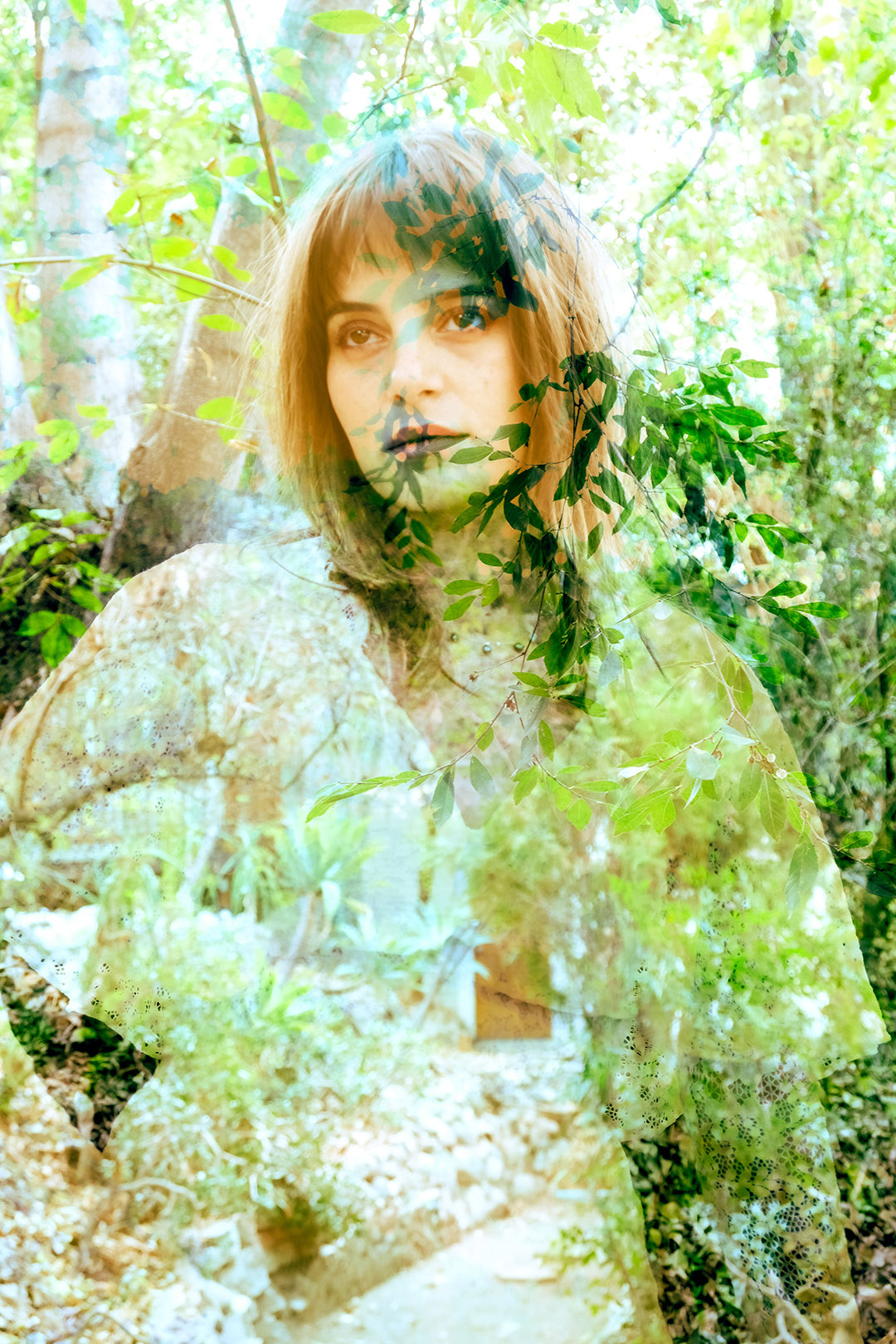
Imperfection makes sense in Aguerre’s world because very little else appears interested in remaining fixed either. Places change language depending on which memory she is entering. Spanish was learned at home, English at school, and both arrive in the lyrics without one being required to translate or justify the presence of the other. Sometimes the decision is almost geographical. Mar del Plata pulls one language forward, San Diego another. Raiatea in French Polynesia occupies another part of the map again. Childhood tends to speak Spanish.
“I often think in both,” she says. “So when I’m sitting down to write lyrics, one will appear first and say, ‘My turn!!’”
French remains slightly more intimidating. Aguerre is shy about writing in it for now, although Raiatea has already contributed to Dream Crease in other ways. Its birds made the album. So did its rain. A language can apparently enter a record without words.
The body works similarly. Aguerre also plays rock music, an experience she describes in almost opposite physical terms to performing Dream Crease. Playing bass can mean pushing through pain until the pain becomes part of the performance, something to use rather than eliminate. Dream Crease asks her body to disappear.
“When I play rock music I am reveling in pain, playing through it and channeling it until I find a way to enjoy it via the music or performance,” she says. “When I am playing Dream Crease live, I fully leave my body and forget where I am. I am everywhere else and nowhere.”
Once she played for six hours and did not realize how much time had passed.
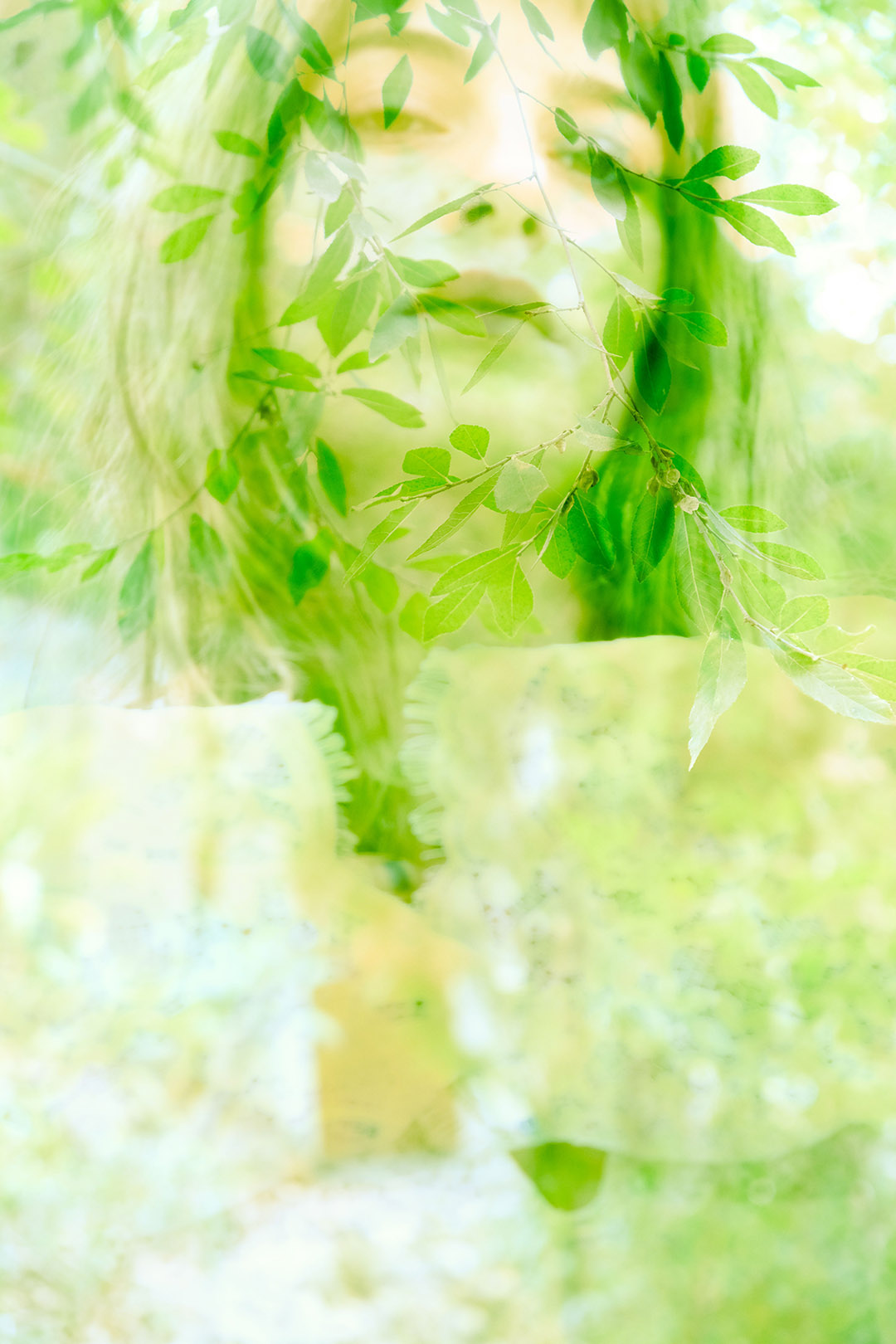
That ability to lose track of the room becomes especially interesting because Aguerre has frequently allowed audiences into the music long before the songs themselves were finished. Much of the new album existed publicly for years as unreleased material, partly for the very practical reason that an artist still building a catalog eventually has to fill an hour-long set somehow. Demos entered the live show because they were needed, then stayed there long enough to become something else.
“Chaos Magician” is the most extreme example. Written back in 2018, it had been in the set since 2021, carrying so much history that eventually Aguerre no longer knew what to do with it. The answer arrived through the PA system. Playing the song at concert volume revealed frequencies and melodic possibilities that had not been obvious elsewhere, and she began constructing vocal melodies from things she could only properly hear when the track was being pushed through a large sound system.
Eventually she handed it to Nailah Hunter.
“I felt she would be the perfect person to breathe new life into the sonic spell.”
That phrase ‘sonic spell’ fits particularly well because Aguerre does not talk about songs as objects that need to be wrestled into submission. They seem closer to environments that gradually reveal what they require. Some arrive immediately. Others spend years making their intentions inconveniently unclear.
“Wandering Ivy” nearly disappeared for the opposite reason. It began as a live arpeggio Aguerre considered “maybe a bit lazy,” until TJ from her label convinced her otherwise. What sounded unfinished from one position had already become convincing from another.
“Some songs get vomited out, others develop over years,” she says.
There is not much romance in “vomited out,” which is partly why it works. Dream Crease may be full of deep-blue skies, tropical rain, hummingbirds and shimmering air, but the process underneath it remains wonderfully practical. Record the bird. Step on the gravel. Put the voice memo into the computer. Play the unfinished song in front of people for three years. Listen to what the enormous speakers unexpectedly reveal. Let somebody else hear value in the part you were preparing to throw away.
Eventually the shape arrives.
“Graciously massage the song with patience and humility,” Aguerre says, “and the final shape will always reveal itself.”
For an artist whose music spends so much time building places that cannot be physically revisited, patience may be the closest thing Aguerre has to a map. The landscape turns up first — in sleep, in memory, in the backyard, beside an ocean thousands of miles from another ocean that sounds strangely familiar — and Dream Crease follows afterwards, trying to work out where she has been.