INTERVIEW
King Howe Is Finding Extraordinary Possibilities in the Smallest Musical Moments.
There is something wonderfully unpredictable about the music Ally Hocking Howe makes as King Howe.
– WORDS BY CJ
A violin melody might unravel into a collection of electronic fragments, a quiet folk song can suddenly develop an elaborate rhythmic arrangement, and voices appear in unexpected places, sometimes manipulated almost beyond recognition, sometimes left so intimately human that they feel like they were never intended for anybody else to hear.
There is a remarkable amount happening in these recordings, yet they rarely feel crowded. Instead, there’s a sense of somebody who has discovered an enormous musical vocabulary and is having a tremendous amount of fun finding new ways to use it.
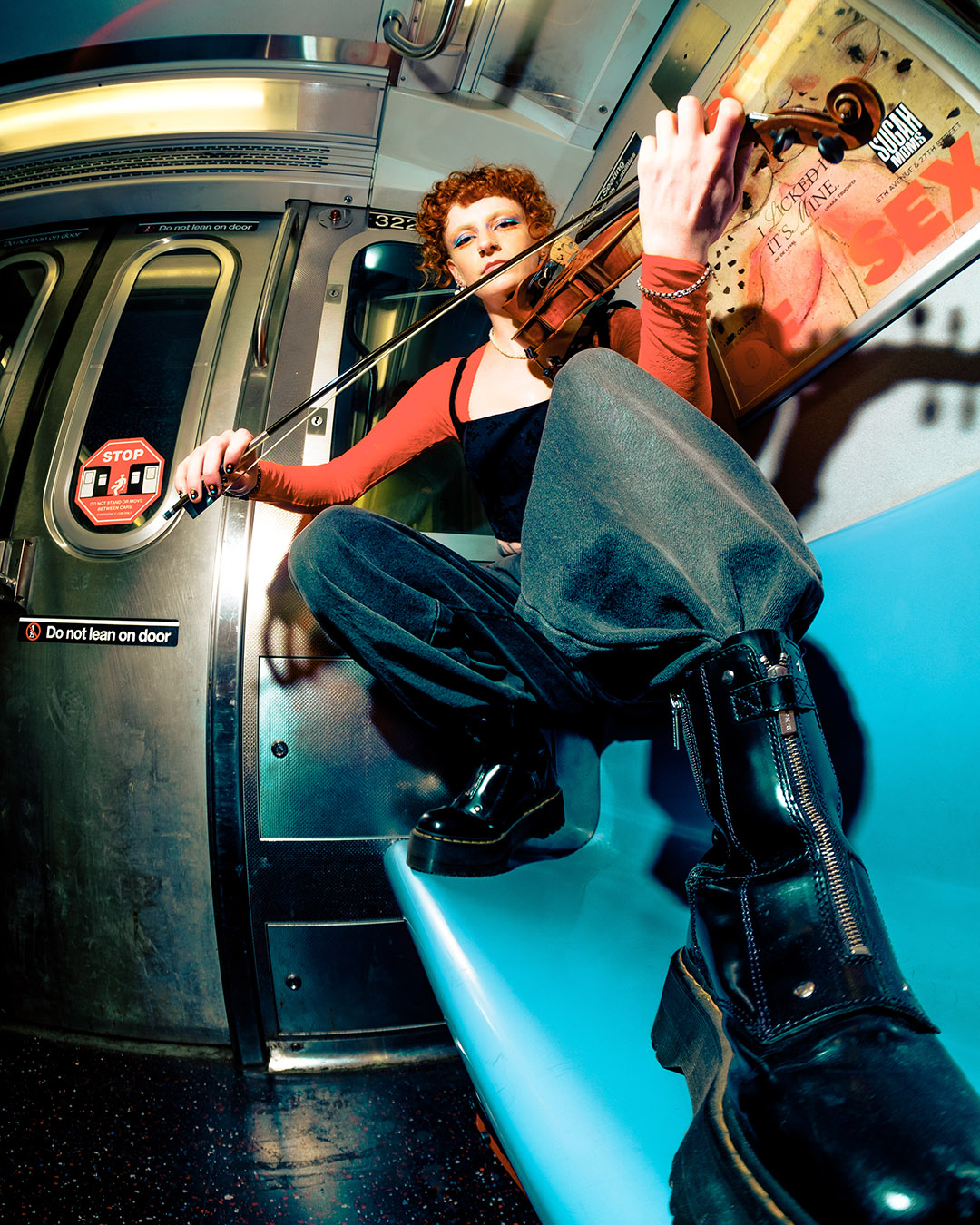
What’s particularly interesting is that this freedom emerged from a musical education that initially left Ally feeling anything but free. Growing up in Australia, she was surrounded by informal musicians and family singalongs, but her own training was rooted in classical violin. She could play the instrument, understand the repertoire and follow the rules, but found herself unable to join in when people began making music spontaneously.
“I have one of those brains where if I understand all of the rules and the parameters, then I feel like I can be creative,” she explains. “But I didn’t know those, and I didn’t know how to improvise.”
PHOTO BY Maria Crane
At eighteen, she made the decision to study jazz, a move that eventually brought her to the United States and transformed her understanding of what she could do with an instrument. Classical theory had always felt disconnected from the act of playing, whereas jazz introduced harmony as something she could immediately explore and manipulate. More importantly, it gave her the confidence to write original music without feeling constrained by what a violinist was traditionally supposed to do.
“Jazz basically gave me the foundation to be able to write original music and to come up with ideas,” she says. Although King Howe isn’t intended to be a jazz project, that education is fundamental to how the songs are constructed, particularly in the space she allows between their many moving parts.
Her recent EP, orange : the ep, offers a fascinating demonstration of that approach. Originally written and largely produced by Ally alone, the songs have spent the past year evolving through performances with her Texas-based band, a collection of jazz-trained musicians whom she actively encourages to bring their own ideas into the arrangements. Rather than asking somebody to reproduce a synthesizer part exactly, she wants to hear what happens when they reinterpret it using their own musical instincts.
The resulting recordings, identified as v2 versions, were captured with eight musicians playing together in a room. Remarkably, the entire EP was recorded in just two takes, with the band ultimately choosing the first.
“I knew that my bandmates were tasteful, but this was a really good demonstration of it,” Ally remembers. “No one was overplaying or trying to be the star of it.”
For a recording featuring so many musicians, the arrangements can feel remarkably sparse. Ally attributes that to their shared musical education, where attentive listening and knowing when not to play are just as important as technical ability. The experience also changed her relationship with the material. Songs like “bear” and “ragged” became almost entirely new experiences, and she found herself falling in love with compositions she had finished several years earlier.
One of the most affecting aspects of King Howe’s music is how comfortably these elaborate musical ideas coexist with intensely personal material. “veronica,” for example, contains a voice message from Ally’s mother Aileen, an ordinary piece of family communication that becomes the emotional center of a beautifully unusual song.
PHOTO BY Maria Crane
Ally grew up with two mothers. One, Taryn, passed away when she was seventeen, and her voice appears throughout “bear,” preserved in messages that Ally incorporated into the recording. Taryn wasn’t a musician herself, but her enthusiasm for music played an important part in encouraging Ally’s own ambitions. Including her voice was a way of keeping that connection present.
Eventually, Ally realized she had never written a song specifically for Aileen, her surviving mother. “veronica” began as a deliberate attempt to change that. She included recordings of her two young nieces, Aileen’s grandchildren, along with the laughter of Aileen’s partner, creating a song populated by the voices of people who belonged to the same family.
Then, while struggling to finish the second verse, Ally went through a difficult period of homesickness. She was living in Texas, her nephew had recently been born back in Australia, and health concerns within the family had made the distance particularly painful. Aileen sent her a long, encouraging message that brought her to tears. Ally asked her to record it as a voice memo, simply because hearing her mother’s voice would make her feel closer.
“As soon as I heard it, I thought, okay, this is verse two.”

PHOTO BY XAVIER KIM
Only as the release approached did she begin wondering whether something so personal could connect with listeners who knew nothing about the people involved. Instead, “veronica” became one of her most warmly received songs. Aileen initially disliked the idea of everybody hearing her recorded voice, but has gradually grown accustomed to its place in the music.
There’s something particularly revealing about that process. Ally’s instinct wasn’t to write a universal statement about missing home, but to include the actual sound of somebody making her feel better. The emotional weight comes from how ordinary the message is, and from the knowledge that the moment existed before anybody thought of turning it into a song.
Her latest single, “milo,” takes the opposite approach musically, although its beginnings were similarly modest. Aileen had suggested that Ally should try writing something exceedingly simple, a catchy song without too many complicated ideas. Ally took the advice and wrote a song for her best friend around a basic two-chord progression.
Predictably, things became more complicated once her bandmates got involved. One bassist suggested transferring a syncopated synthesizer pattern into the bass and drums, fundamentally changing the rhythmic character of the song. Ally then decided to embrace the deliberately excessive production of contemporary pop, creating something bigger, faster and considerably more crowded than anything she had previously attempted.
The vocal arrangement alone contains approximately twenty layers, including shouted performances recorded while Ally moved around her room. Some were pitch-corrected and others deliberately left untouched, producing the sensation of several people singing together rather than one voice being multiplied into perfect alignment. She wanted the production to feel energetic and human even at its most artificial.
That relationship between technology and physical performance is central to King Howe. Sometimes Ally begins writing directly inside Ableton, allowing production and composition to happen simultaneously.

PHOTO BY XAVIER KIM
Other songs begin acoustically before she works out how to introduce electronic elements. As a violinist, she also sees technology as a way of escaping the limitations of an instrument that generally produces only one or two notes at a time. Loops, harmonizers and digital effects allow her to build entire harmonic environments around those individual melodies.
She points to seeing Dijon perform in Dallas as a particularly inspiring example. His songs remained recognizable, but the arrangements had been completely reconsidered for the live setting. It’s the kind of freedom she wants King Howe to retain, particularly as the project becomes increasingly collaborative.
Ally began playing music within a system that made improvisation feel inaccessible, and has now built an entire artistic identity around the possibility that any song can become something else.
The recordings are meticulously constructed without ever feeling rigid, full of unexpected musical decisions that serve the songs rather than distract from them. There is an instinctive quality to Howe’s work that makes even its most complicated arrangements feel remarkably natural, as though each new idea has simply uncovered something that was waiting to be heard.
With “milo” and a growing creative relationship with the musicians around her in Texas, Howe appears increasingly comfortable following those instincts wherever they take her. What makes her such an interesting artist to follow is that she seems every bit as curious about what she hasn’t made yet as she is proud of what she’s already accomplished.