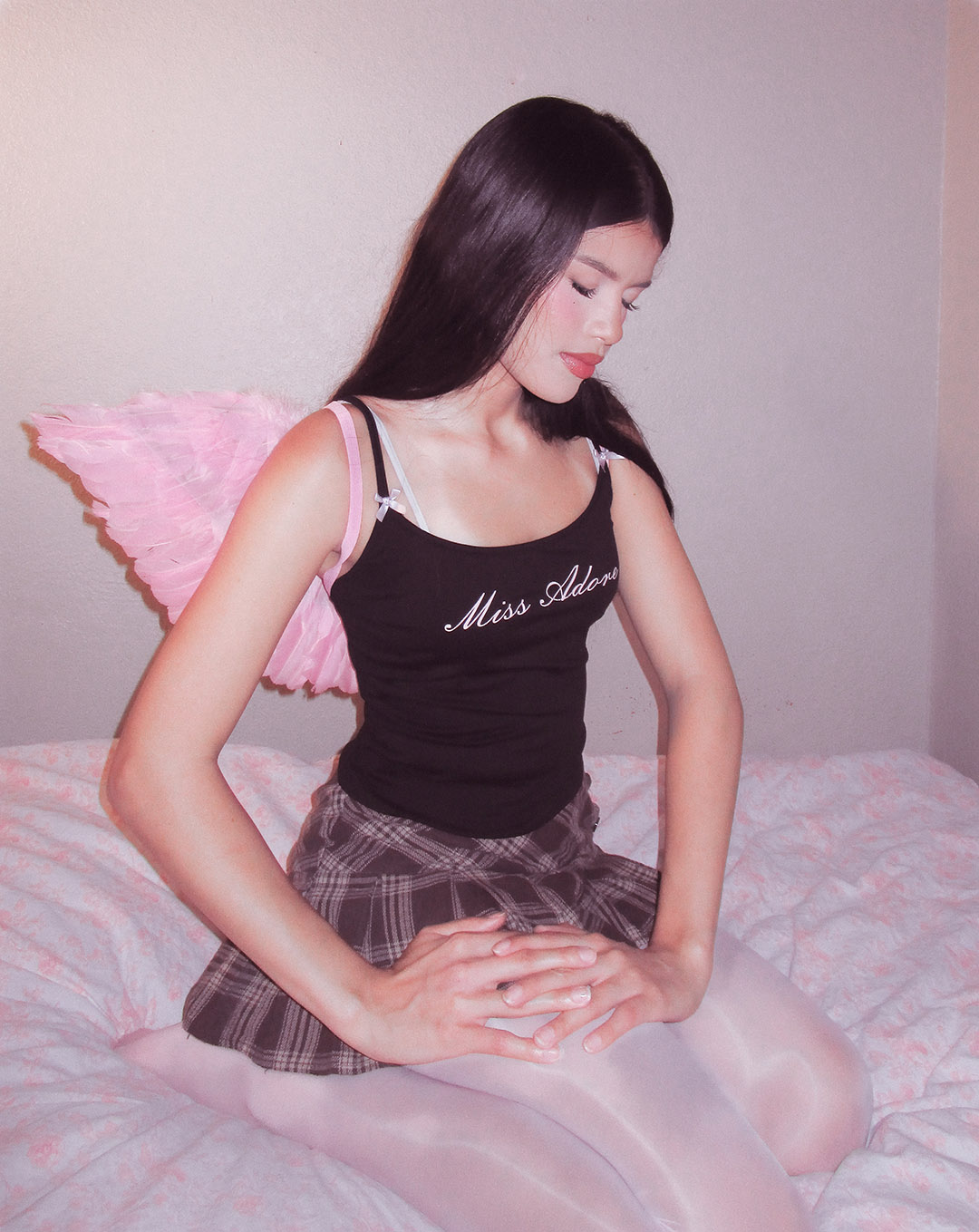
Luna Avelar Built a World Called Blushed.
There is a point in Luna Avelar’s description of “Mint,” the longest song on her record Blushed, where she stops talking about music altogether. The first half, she says, feels like rain coming down hard. The second is the moment the sun begins pushing its way back through the clouds. It is not really a metaphor she has prepared.
– WORDS BY CJ • PHOTOS BY Cecilia Duran
It arrives because this seems to be how Avelar understands songs: not simply as melodies, words or arrangements, but as places with weather systems of their own. Blushed, she has said, lives somewhere among teal nights and pink sunsets, and when she talks about the record it becomes increasingly clear that those colors aren’t decorative. They are part of the architecture.
That instinct is all over Blushed. It is dreamy without disappearing into itself, personal without becoming claustrophobic, and sad without ever seeming particularly interested in staying sad. Avelar began many of its songs with things she had written privately in her diary, often during a period of her life she now describes as melancholy and stagnant. Sometimes, even in the middle of writing something painful, the songwriter in her would interrupt. “I’ll write certain phrases, and even though I’m really sad in the moment when I’m writing it, I’m like, ‘Ooh, this one’s really good. This would make for a good song.’”
Not everything makes the crossing. Some thoughts remain hers. Avelar is comfortable making vulnerable music, but vulnerability does not mean handing over every private detail simply because an audience is willing to listen. There are things in those diary entries she deliberately keeps outside the songs because they still feel like too much.
What does survive that edit becomes something stranger and more useful than autobiography: a record about being caught inside feelings that seem enormous while you are experiencing them and discovering later that they were not, in fact, the end of the world.
That distance between then and now has changed the way Avelar hears the record herself. She remembers believing certain moments were catastrophic. Today she can return to those songs and recognize both the seriousness of what she felt and the temporary nature of it. “I like looking back and knowing how I felt then when I was writing these songs,” she says. “It just reminds me of how powerful your emotions can be.” There is something quietly funny in the conclusion she can draw now: she genuinely thought everything was ending, and yet here she is. Fine.
That perspective is perhaps why Blushed never sounds defeated. Even when the songs are rooted in endings, Avelar seems drawn toward what might arrive after them. She has come to believe that things which no longer belong in your life eventually stop aligning with it, and that insisting on keeping them can prevent something else from finding its way in. It is a remarkably orderly philosophy for an album born out of disorder, but it gives the record its forward movement. The optimism is not the denial of something painful. It is what appears once the pain has been allowed to exist.
The sequencing makes that transformation difficult to miss. Blushed opens with “Dream Of Me” and closes with “Goodbye,” titles that almost insist upon being read as two ends of a relationship. Avelar did think about the record as a story when she assembled it, although not one required to hit every traditional emotional checkpoint along the way. “Goodbye,” for her, represents acceptance, the final stage in the familiar progression through grief. The songs between those points do not map each stage neatly, because actual people rarely move through emotion that neatly either. What they do capture is movement.
For Avelar, that movement can also happen between languages. She grew up speaking Spanish and learned English later, first in part through Dora the Explorer, then through school and the American television she watched as a child. She can still remember what English sounded like before she understood it, something most bilingual people are never able to recover once the language becomes familiar. She remembers borrowing phrases from television simply because she liked the sound of them, carrying them into school without necessarily knowing exactly how they would land.
Now she sometimes finds herself thinking in Spanish while writing in English. Other times Spanish becomes the only language capable of getting a thought exactly where she wants it. There are ideas and phrases, she explains, that refuse to cross over cleanly. Translating them changes something. So she does not force the translation. On Blushed, the movement between Spanish and English feels less like a device than a reflection of the way Avelar already experiences language internally, two systems operating alongside one another and occasionally finding that one can reach somewhere the other cannot.
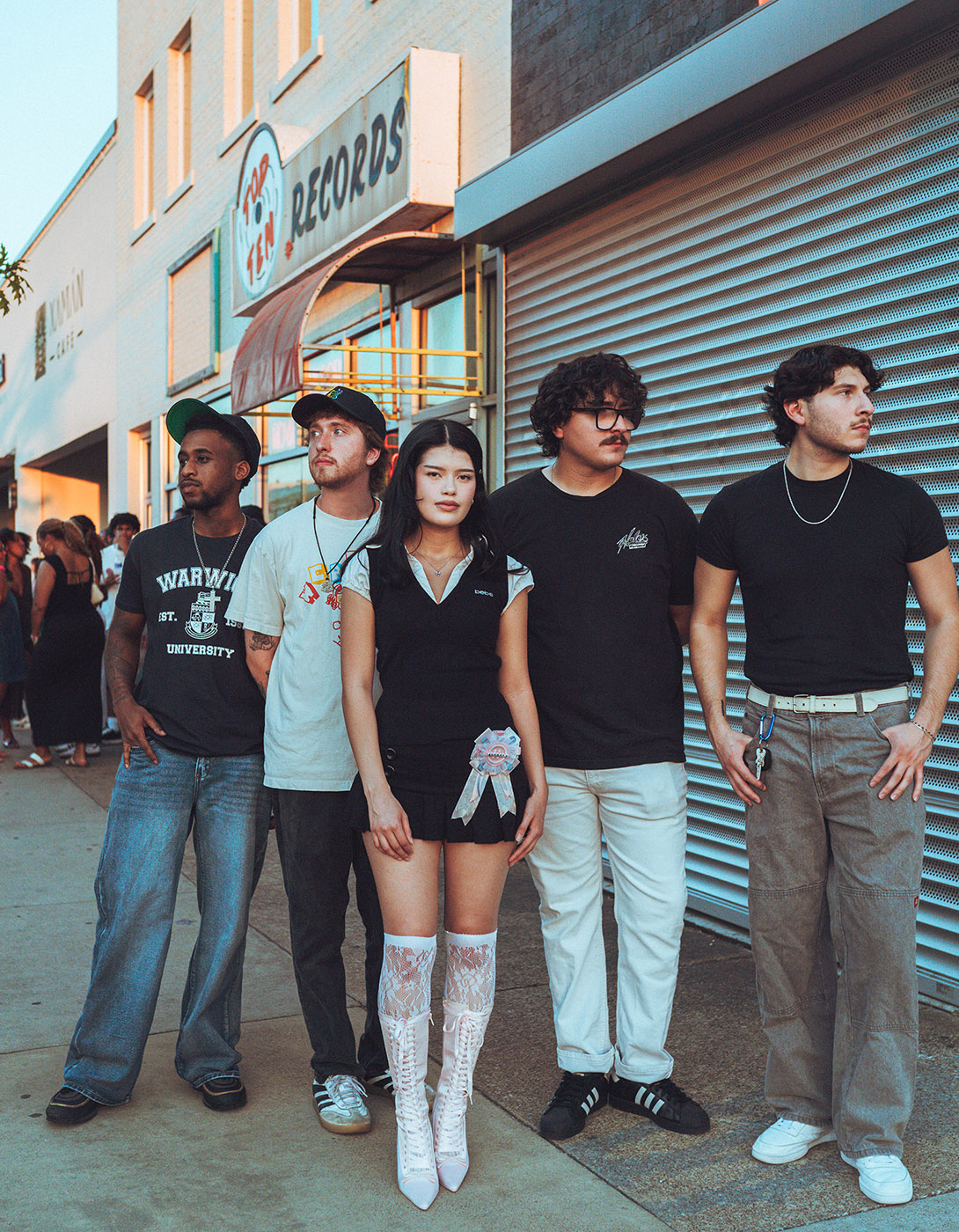
The other significant change in Avelar’s music happened when songs that had largely begun alone in her bedroom suddenly acquired a band. She produced “Dream Of Me,” “Explicacion” and “Vuelve” herself before working with her bandmates on songs including “Mint” and “If I Stay.” On paper, the match should perhaps have been awkward. The musicians she approached came from a much heavier punk and metal background than Avelar’s soft-focus pop, and even she was uncertain whether they would be interested.
The invitation came because of a benefit at Four Down, a Dallas skate park, raising money for immigrants affected by ICE enforcement. Avelar already knew drummer Sam Caseras through mutual connections and asked if he and the other musicians might back her for the show. She expected them to turn her down. Instead, they agreed, and the musical distance between them quickly became the reason the collaboration worked.
“I feel like we’ve definitely influenced each other,” she says, describing the collision of their heavier instincts with the dreamier world she had already created. That exchange has become one of the most interesting things happening inside the music. The band does not simply recreate the bedroom recordings at a louder volume. They introduce another physical language to them, something capable of pushing against Avelar’s softness without overwhelming it.
“Mint” is where that expansion becomes clearest. Most of Blushed operates with a remarkable economy, songs arriving, establishing their world and leaving before the atmosphere has time to thin out. “Mint” refuses that brevity. Avelar simply had more to say, but she also wanted the ending to stretch because the feeling itself seemed to require it. That is where the rain-and-sun image appears: the first section caught inside the downpour, the second slowly allowing light through. She wanted the song to leave the listener with the sense that, ultimately, there is more good than bad.
It is easy to understand why Avelar talks in pictures once you hear how deliberately she imagines the world around her songs. She wants Blushed to be immersive, not only sonically but emotionally, somewhere listeners can enter for a while. Part of that impulse comes from her own relationship with the artists who helped her through difficult periods. Hearing somebody else articulate something familiar can make private misery feel less solitary. If another person has survived the thing you are currently convinced you will not survive, perhaps that evidence is enough.
A love for Mazzy Star makes immediate sense in this context. Avelar lights up at the mention of the band and Hope Sandoval, another singer whose voice has often seemed capable of making an entire room change temperature without ever needing to dominate it. But Avelar is already thinking beyond the dream-pop language people might naturally use to categorize Blush. Her appearance on Jam City’s Trippin’ placed her inside a different musical environment, and she welcomed the disorientation of it.
“I don’t want to just dab onto one genre of music and just be classified as, like, a dream pop artist or alternative whatever it is,” she says. Working with different producers and artists, changing how she writes and putting her voice somewhere unfamiliar are becoming part of the project. Versatility, to Avelar, is not about demonstrating that she can perform a series of styles on command. It is about refusing to discover too early what Luna Avelar is supposed to sound like.
There is already evidence that the music is escaping whatever boundaries she might once have imagined for it. When Avelar began performing these songs, almost none of them had been released. She would watch people in the crowd nod along or sway to music they were encountering for the first time, uncertain what any of it might become once the songs existed outside those rooms. Now she looks out and sees people singing the words.
That change still surprises her. The songs that started in diary entries, then became bedroom recordings, then became arrangements worked out with musicians from a completely different musical background have somehow completed the journey back into other people’s mouths. For an artist who once said she would be satisfied if even one person recognized themselves in what she had written, it has created the possibility of wanting more.
And perhaps that is the real story inside Blushed. Not simply a relationship beginning at “Dream Of Me” and arriving eventually at “Goodbye,” but the widening circle around the songs themselves. A private thought becomes a lyric. A lyric becomes a recording. A bedroom recording finds a band. The band finds a room. The room fills with people. Eventually, those people know the words.
Avelar wanted to build somewhere listeners could disappear into for a moment, but Blushed works because she never confuses disappearing with escaping. She believes there is value in sitting inside an emotion long enough to understand what it is trying to tell you. Sometimes you come out carrying a lesson. Sometimes you come out with a song.
And sometimes, if you stay there long enough, the rain stops.