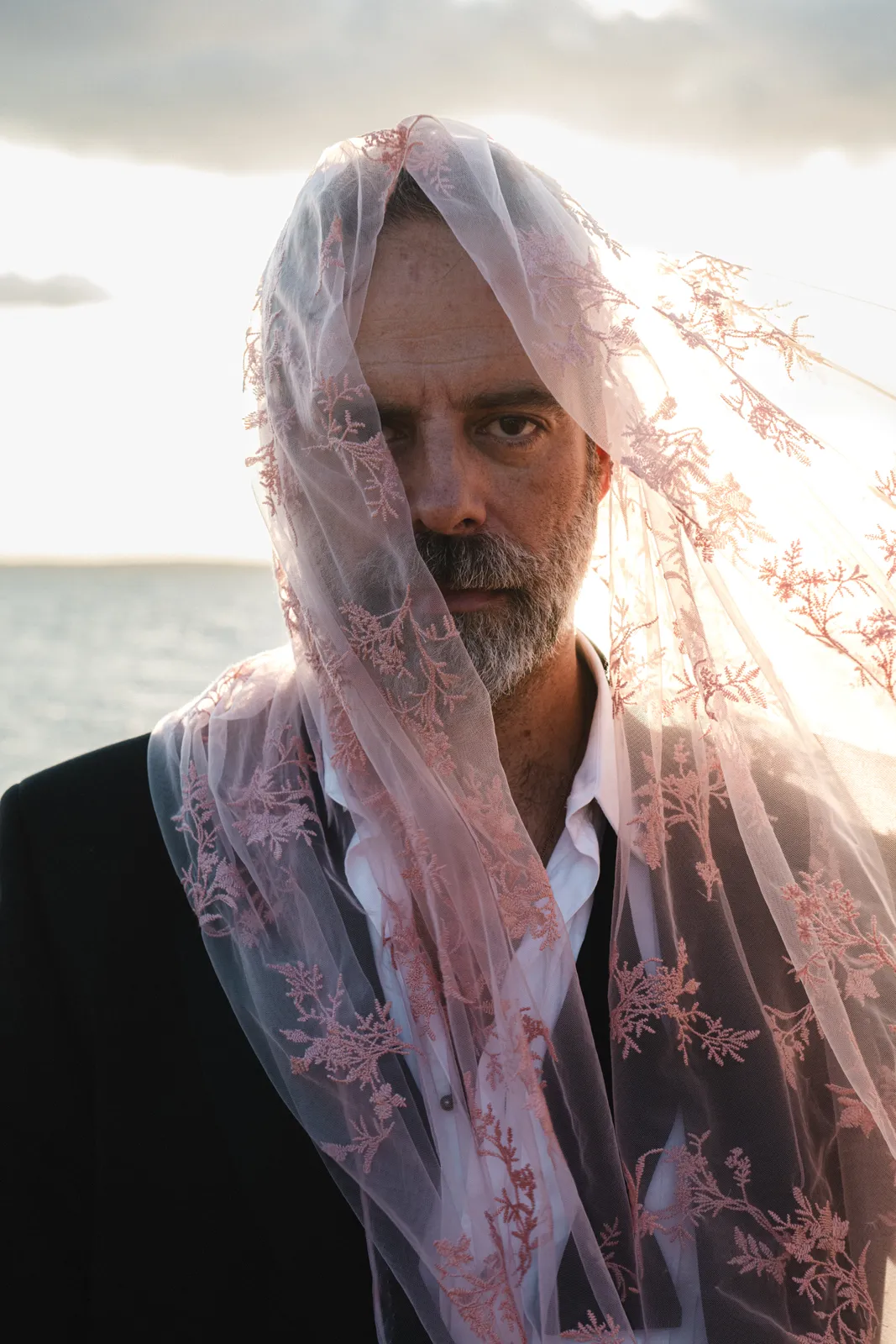
MATT OF MATTS HAS SOME STRANGE HYMNS TO SING.
There was a time when Matt of Matts played in a Dallas hair-metal cover band called Stan Halen. They once performed a selection of Mötley Crüe songs for Nikki Sixx himself, which must have been quite an afternoon. These days, Matt makes synthesizer music about religious trauma, collapsing stars and the terrifying business of starting over. Nikki Sixx might have questions.
– WORDS BY CJ • PHOTOS COURTESY OF MATT OF MATTS
Before Stan Halen there was a college band in Houston, some attention and college radio play. Afterward came years of writing and recording at home, without finishing much. Children and a career took priority. The songs accumulated anyway, some unfinished for decades, until something shifted this year and he decided to let people hear them.
“I’ve always just made music for myself on the side, secretly,” he tells me. “I just never finished stuff.” He began revisiting abandoned recordings, writing new material and assembling his debut album as Matt of Matts, Strange Hymns. An odd debut from somebody who’s spent thirty years making music, although the timing feels appropriate.
Matt grew up in a household where the approaching end of the world was discussed with considerable conviction. His father was an evangelical exorcist who taught at Dallas Theological Seminary, associated with evangelical teaching about the Rapture and biblical prophecy. His mother had entered a Catholic convent at fourteen, only to leave two years later because she thought the nuns weren’t sufficiently serious about God. She eventually found American evangelicalism.
“Digging out from under religious trauma is kind of the central story of my life,” Matt says. He remained a believer well into adulthood and describes the aftermath of leaving that world as “emotional wreckage.” Music and writing helped him examine ideas once presented as unquestionable facts.
Whatever you make of the theology, Christianity has assembled an extraordinary visual and emotional vocabulary. There are angels, miracles, resurrection, sacrifice and all those magnificent paintings of people looking toward heaven receiving dramatic news. It would be a shame to surrender the entire vocabulary because you’ve stopped believing its teachers.
“There’s a lot that I grew up with that’s just still part of the machinery of how my brain processes reality,” he explains. “Rather than reject it entirely, I’ve tried to just reframe it.” He wants to preserve the reverence, he says, while discarding certainty, dogma and doctrine. The world can still be mysterious, even sacred, without somebody explaining what it means. It’s an unusual inheritance: the need to feel awe, coupled with a deep suspicion of anyone offering instructions about precisely where that awe belongs.
That thinking runs through Strange Hymns, a record whose songs Matt describes as anti-hymns. An anti-hymn presumably retains something of what it’s reacting against. These songs still contain a strange devotion. Matt agrees, without wanting to name its object.
“There’s a piece of it that I really want to keep,” he says. “This sense of smallness and even worshipfulness for something that I neither have a name for nor want a name for.” Then comes a lovely observation: “I almost feel like there’s more room for worship the less I know about what the object of that worship is.”
What makes the album engaging is the music underneath those enormous questions. Rather than surrounding difficult subjects with reverential solemnity, Matt builds restless rhythms out of drum machines, analog synthesizers, glitches and odd sounds. The songs concern themselves with divorce, death, ageing and various forms of extinction, yet quite often they sound as though somebody has decided to dance through the apocalypse.
There’s a reason for that, and it’s more personal than a fondness for an interesting beat. Matt recalls undergoing EMDR therapy and learning a physical grounding technique involving alternating movements, left and right, across the body. He discovered how something as simple as rhythm could help him process difficult emotions. Eventually that sensation worked its way into his songwriting.
“There’s something about the process of healing for me that needs to involve the body,” he explains. The rhythmic, beat-driven arrangements were a deliberate choice, even for painful songs. The movement gives the words a place to go.
It also helps explain his admiration for John Darnielle of the Mountain Goats, particularly the extraordinary “No Children,” a divorce song so wonderfully vicious and strangely exhilarating that it’s difficult to imagine it any other way. Matt admires Darnielle’s sincerity, his willingness to sound angry, childish or unresolved without pretending to have attained some grander wisdom. He mentions a quality of literary intelligence sitting alongside childishness, which is a pretty good description of great songwriting.
I ask him about the curious contradiction at the center of the record. He’s finally introducing himself as a solo artist, opening a completely new chapter, yet so many of these songs concern endings. The opening track, “Matching Horses,” establishes that preoccupation, while the closing “You Are Holy Ground” arrives somewhere quite different.
Matt calls the latter “a post-death resurrection dance number,” which might be my favorite description of a song this year. The idea was to move through fear and loss toward the possibility of another beginning, without promising that whatever came next would be comfortable.
He wanted to “close the door on a lot of fear and a lot of big heavy topics” and open another onto something unknown, possibly still terrifying.
We talk about Joy Division, and how their reputation for darkness can obscure what a thrilling band they were, before finding our way to Stereolab. Matt spent years obsessively listening to them, drawn to the repetition, warmth and hypnotic electronic character of records that often have quite complicated things to say. The Magnetic Fields were another significant influence, particularly Get Lost. He isn’t claiming to sound like either band, although you can recognize something of their willingness to make intellectually demanding music that also rewards the simple act of listening.
His own fascination with synthesis began years ago when, having played bass, keyboards and French horn, he bought an analog synthesizer and discovered he enjoyed building odd sounds as much as writing songs. He learned patch bays, matrices and oscillators simply because the process was fun. You can hear that pleasure in the finished recordings. A strange noise will wander into a song, hang around just long enough to become familiar, then disappear again.
And then there’s the publicity photograph. Matt stands on a mountain holding synthesizers like Moses presenting the tablets, except he’s wearing athletic sweatbands and looks rather like Björn Borg preparing to deliver the Ten Commandments at a rave. I tell him this, and he’s delighted. The biblical imagery was intentional; the sweatbands were introduced because the whole thing looked far too serious without them.
His first proper public presentation of the project takes place at The Wild Detectives in Dallas, where he’ll perform with his daughter and a friend alongside readings from author Will Clarke, whose new book, The Pentecostal Home for Flying Children, shares some of the record’s fascination with unusual religious childhoods. Matt has previously played house shows, but this will be the first time the three-person version of his music meets a general audience.
There is something fitting about that. After years spent navigating a world in which the answers were supposedly already written down, Matt has made an album that seems more interested in asking questions. Thirty years after his first band, he’s finally releasing the songs, happy not knowing what comes next. At least this time, he’s brought the synthesizers.