Mildred Is Trying Not to Ruin a Good Thing.
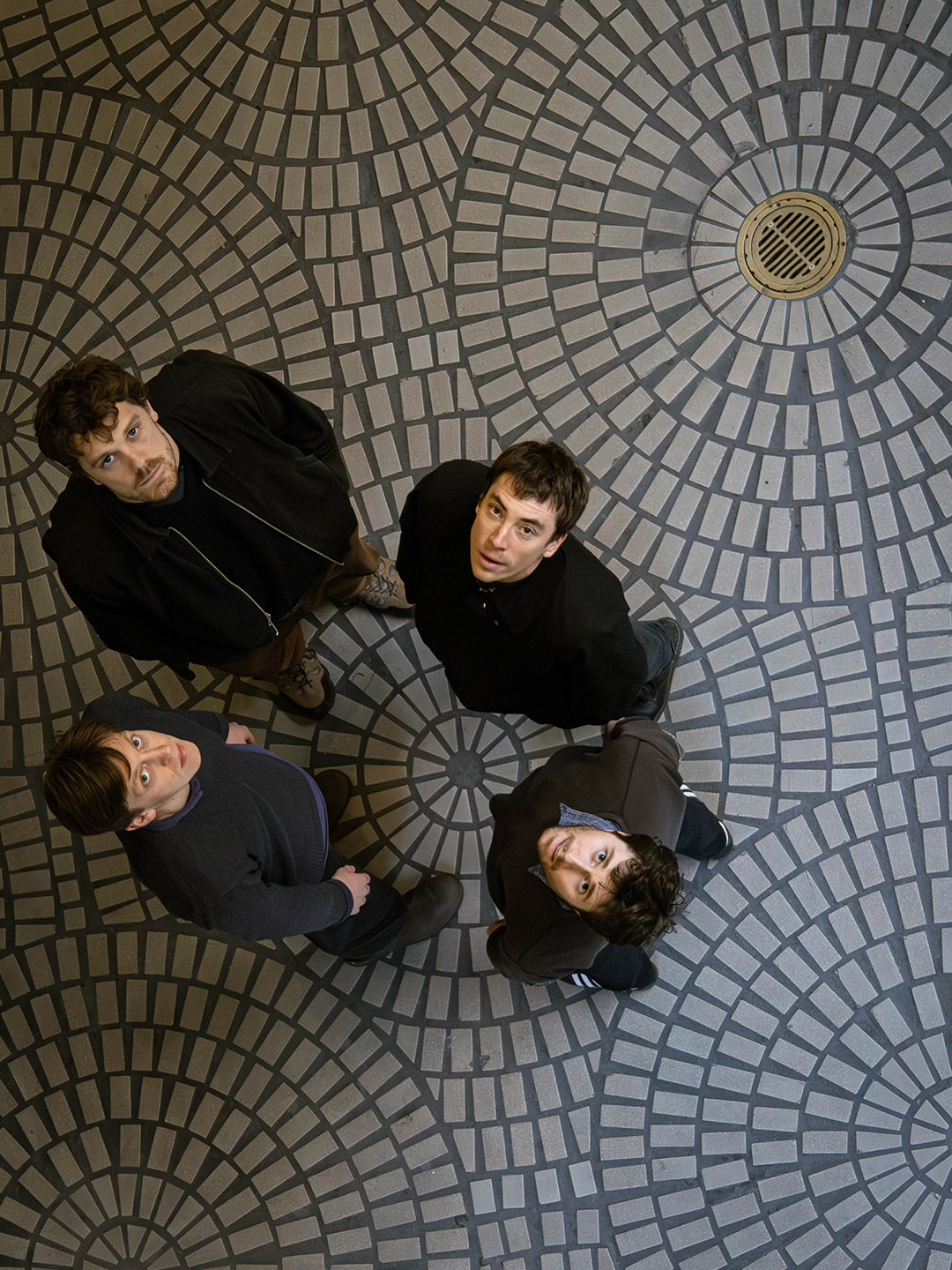
Jack Schrott hopes Mildred never becomes too successful to waste an afternoon on a song nobody will hear again. The Oakland quartet has spent 2026 discovering what happens when music made among friends attracts a wider audience.
– WORDS BY CJ • PHOTOS COURTESY OF MILDRED
Their debut album, Fenceline, has brought reviews, tours, and sold-out shows, but Schrott wants to preserve a less marketable part of being in a band. “I hope we continue placing the highest value on songs that happen once in the garage and then never again,” he tells JAMBALOO. It’s a clear statement of priorities from a group whose rise has been as unplanned as its beginnings.
Mildred came together through friendships. Henry Easton Koehler and Schrott played guitar, Matt Palmquist played bass and other instruments, and drummer Will Fortna joined whenever he was in town. The earliest songs grew out of a house in Berkeley, with instruments picked up before or after dinner. They eventually moved into a garage, where playing remained one reason to spend time together. If attention threatens to change anything, Palmquist wants to protect that arrangement. “Time,” he answers when asked what he values most. “All the other stuff allows us to have dinner together, play music, fool around in the garage, that’s what I care about most.”
Fortna agrees that hanging out without an agenda is central to the project. It’s harder to maintain once people expect records and shows. The band’s four-way structure helps. Mildred have no designated frontman, and all four bring songs and ideas into the room, making it difficult to treat an arrangement as the property of whoever first played it.
Koehler hasn’t found a piece of writing he’s reluctant to share, and the possibilities interest him more than what fits a recognizable band identity. “I think Mildred can be capacious,” he says. “I don’t worry about what it is and isn’t, or what it can and cannot accommodate. I hope we go through a weird bedroom pop phase.”
Schrott feels similarly free to bring material into rehearsals, though he notes a distinction that would barely have existed when they started. Any hesitation now is likelier to concern the people outside the room who might eventually hear the song than his three bandmates. Palmquist approaches the process from an even wider angle: he doubts people have many original thoughts, himself included, and sees songwriting as a matter of receiving common experiences through different individual perspectives. Those perspectives give Mildred several ways to approach the same subjects. The fact that nobody is required to make every decision from a single viewpoint is one of the group’s strengths.
On Fenceline, released in April through Memorials of Distinction and Dog Day Records, guitars catch against one another, the singing changes hands, and arrangements leave room for each musician. Asked how much work goes into making the songs sound spontaneous, Palmquist offers an explanation that may be only partly serious: “That is pretty much how it happens. I attribute it to Henry’s famous vinaigrettes.” Schrott is more specific. He likes that the group can be coordinated and uncoordinated at different moments, and that something stumbled upon in rehearsal can become a permanent detail of the song. An accident becomes an arrangement because the others recognize its value.
Mildred took time away from work to record much of Fenceline at Luke Temple’s studio in Los Angeles, while “Fish Sticks” received a separate session with Jack Ogborne, better known as Bingo Fury, in Bristol. Its guitar lines and harmonies sit comfortably beside the material recorded elsewhere. The album’s everyday settings are as distinctive as its musical turns: cars, bosses, dust, errands, food, friends, and small encounters accumulate across the songs. Very little is dressed up as a revelation. Details can be funny, dull, unsettling, or beautiful depending on what happens around them.
Palmquist has little patience for the idea that a song needs a suitably important subject. He detours into Franz Schubert’s lieder, compositions set to poetry and associated with formal conventions, before arriving at a more democratic view of art.
He enjoys the rituals of sophisticated culture but doesn’t think they should decide who participates. “There’s beauty in everyday objects,” he says, “and we should celebrate that without pretext.” On Fenceline, observations move from mundane comedy to discomfort within a verse. The band’s humor can also deflect emotion or bring it closer. Asked which, Palmquist answers simply: “Always.”
The music has inevitably attracted the usual comparisons: Pavement, Silver Jews, alt-country, and the increasingly elastic category of slacker rock. The band likes those artists, and Schrott says many were early reference points in their friendships, so he understands why listeners hear connections. He also notes that the four of them have spent years getting interested in hundreds of other musicians. Koehler is grateful people are paying attention at all, though he suspects he’ll be less delighted if critics are still reaching for exactly the same references several albums from now. Palmquist takes a more pointed view of the terminology. “Does being a slacker actually ‘mean’ we don’t play very well? Damn.”
Time is a more useful thread through the album than any genre label. People leave, spaces change, and memories acquire new associations, but Mildred rarely stop a song to explain what the listener should take from it. Palmquist is particularly resistant to retroactively assigning significance. “Moments do not mean anything,” he says. “They are how we define the passing of time, and I feel happy that these songs capture our lives in that moment.” Schrott is blunter still: “The songs focus on what they know, which is what’s happening. Trying to get the meaning, you’ll get it wrong.” It’s an approach that leaves an unusual amount of interpretive work to the listener, despite the specificity of the lyrics.
That openness has become more noticeable as the audience grows. Koehler heard from someone who listened to Fenceline while driving home from the hospital with their newborn, an association that stopped him short.
Schrott enjoys receiving interpretations of lyrics, even when they differ from his own. To him, that exchange is part of what lyrics are for. The band may know the circumstances behind a song, but those circumstances needn’t determine everybody else’s experience. The music has begun collecting memories that belong to people Mildred have never met.
The September single “Bird Laugh,” released after Fenceline, offers another angle on the band’s relationship with change. Schrott wrote its lyrics, and when asked whether accepting what can’t be controlled has become more important to him, he admits that generosity toward change occupies more of his thinking as the years pass. He suspects it will surface in some of the new material. As with the album, though, the idea is not being turned into a grand plan for the band’s next phase. Koehler says he considers how songs relate to one another only after they’re finished; deciding their sequence is part of the pleasure of making an album, not a set of instructions that needs to be followed before the writing starts.
Fortna says the group rarely discusses an overarching sound, preferring to let arrangements develop from whatever someone brings in. He jokes that his limitations as a drummer may impose their own boundaries. Palmquist has a more ambitious stylistic proposal. After his excursion into Schubert and the freedom of everyday subjects, he announces that he’s “working on becoming the first Schubert-rock band out there.”