Saba Lou Is Learning to Trust the Part She Can’t Explain.
With her new album, Nothing But Love, the Berlin songwriter brings science, instinct and a changing sense of self into the same room, discovering that making music doesn’t always need a reason beyond the act itself.
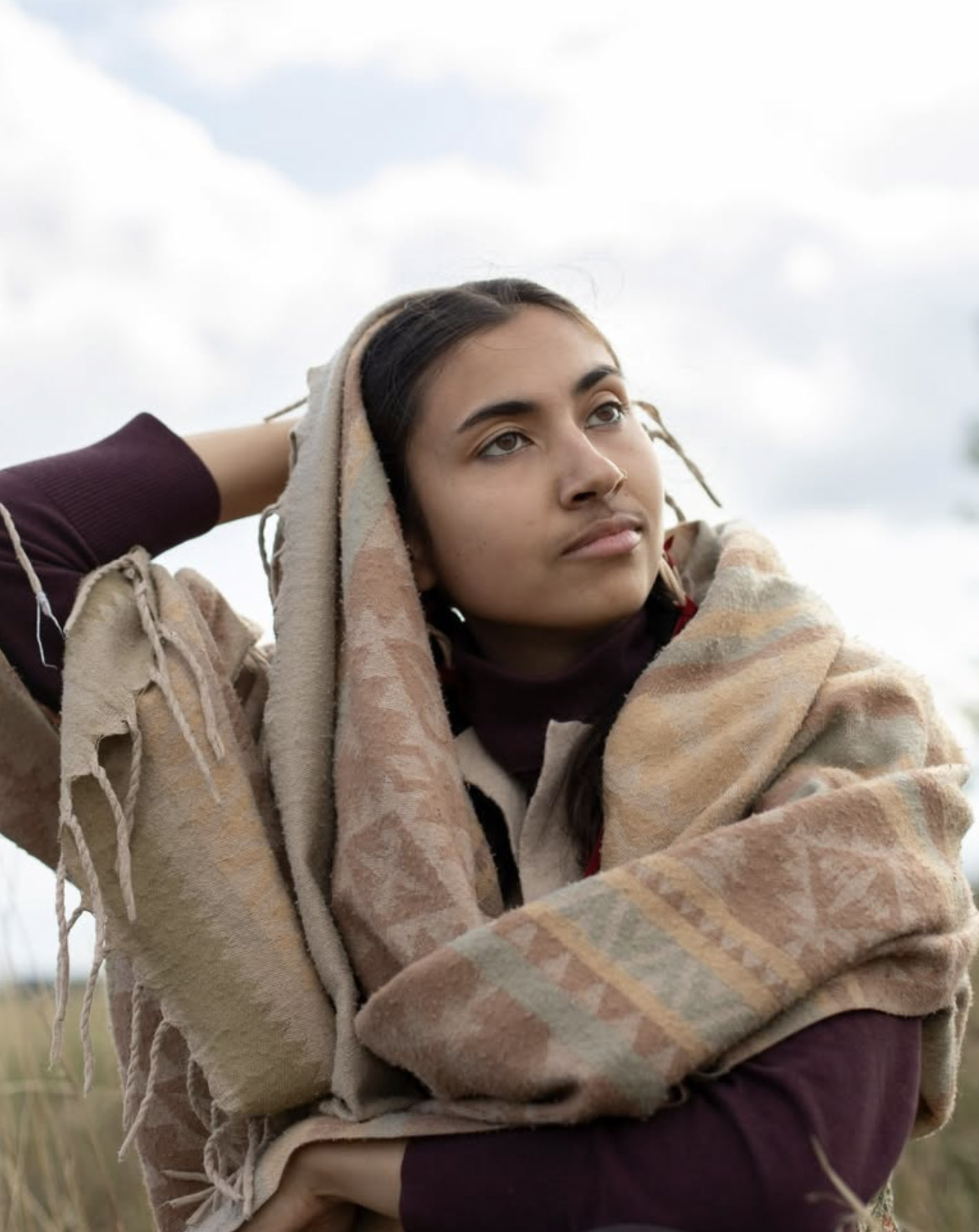
– WORDS BY CJ • Photo by julia autz
In a biochemistry lecture, Saba Lou encountered the standard hydrogen electrode, a reference point in electrochemistry whose abbreviation happens to be SHE. Lou saw a person. “From that second on, I wasn’t looking at it as any kind of technical device at all anymore,” she remembers. “Immediately I was like, ‘Okay, so this is a person.’” The more she learned, the stronger the character became: demanding, requiring specific conditions, difficult to work with and yet indispensable. “I found that so interesting and so easy to map onto a personality,” she says. “And so to me immediately this, like, diva emerged.” Naturally, she wrote a song about her. “She” is now a single from Nothing But Love, Lou’s third album, due November 20 on Ernest Jenning Record Co.
It’s an unlikely origin for a pop song, but it makes sense when you consider Lou’s path since her previous record. She released her first four-song seven-inch at six, recorded Planet Enigma at fifteen and made Novum Ovum while still a teenager. Her father is musician King Khan, and the family connection long shaped how people understood her work. Then she studied biochemistry. “My paternal grandmother was a microbiologist,” she says. Her maternal grandparents were interested in botany, zoology and gardening, and she had enjoyed chemistry and biology at school. University offered another kind of life, “something just completely outside of what my family life kind of… what I knew from my parents.”
Time away from releasing music has made her relationship with it simpler. “I think if anything it’s gotten easier because I’ve just figured out my relationship to it more and more,” Lou says. “Just me separate from my family. What do I want from it, and why do I like doing it? What is my motivation to write songs and wanna record them and perform them and show them to people?” Those questions can get lost when an artist begins so young that public expectation arrives before adulthood. Her new record allows earlier versions of herself to occupy different parts of the same album.
The first side of Nothing But Love was written across roughly four years, its songs belonging to an earlier period than those on the second. The division emerged naturally. “The A side is further in the past, and the B side, even though those songs are also a few years old at this point … still feel a lot more relevant,” she says.
“It just feels like a nice summary of all of these years that I spent kind of halfway away from music, and it feels nice to document all of that and then move forward.” The first side retains the observational quality of Novum Ovum, while the second turns toward experiences she couldn’t examine when she was younger.
“The B side is more about these internal experiences that I hadn’t noticed that way before, or hadn’t had maybe the ability to look at,” she explains, “because it requires a certain type of stillness and maturity or a kind of patience to look inside in that way.” The title track, which addresses her spiritual life more directly than anything she’d previously written, arrived before she could articulate what she was experiencing. “The songs were written kind of like a natural bodily expression,” she says. “Kind of like I needed to write them. I didn’t intend for them to be released. I wasn’t thinking in a music industry way when I was writing them.”
She wasn’t explaining her spiritual experiences and then finding melodies to support the explanation. She was responding through the language she knew, understanding the response later. “Something is happening to me, and this is a medium that I’m used to expressing myself over, so I’m gonna write songs about it,” she recalls. The songs now have a clarity she didn’t possess when she made them. “Now when I listen to them, I can actually … understand them better in a way.” She brings up a description of intuition she associates with Sherlock Holmes: intelligence working too quickly for consciousness to process. “It kind of all happened in the subconscious,” she says. “I was learning all of these facts and having experiences that I didn’t have before, and then I just wrote these songs kind of as a reflex.”
The arrangements have changed, too. The melodies retain an affection for economical older pop, but there’s more rhythmic movement. “It just offered itself naturally to use the musical level itself as an arena to bring more complexity,” she says. “There is more rhythmic complexity than I was writing before.” Her explanation is also practical. “I’m still not that great a guitarist, but I’m a better guitarist now than I was during Novum Ovum … and I write my songs on guitar.” Those skills gave her more possibilities without a deliberate decision to make an elaborate record.
Lou has also formed The Khan Sisters with Bella Bizarre and Omri Gondor. Omri played drums on her previous and current records and is a close friend; Bella is her sister. The two women grew up singing together and listening to the same music, but had never made a project like this. “My sister and I have never performed in this way before, as our own project,” she says, “but we grew up together listening to the same music.” They have spent recent years “becoming friends on top of sisters,” and making music together now feels “really therapeutic and nice.”
Lou is also making her acting debut in Identitti, directed by Randa Chahoud and adapted from Mithu Sanyal’s novel. The casting invitation amused her. “Yeah, I don’t know why you think I’m an actor,” she remembers thinking, but she went because declining meant missing an experience. On set, she found familiar ground: performing under lights, using her voice, recognizing the moment to begin. The production incorporated singing into her part, and composer Burak Özdemir introduced her to the box tanpura, an instrument she had never played. An experiment outside her field became another musical encounter.
Lou is less interested in measuring activities against a career plan. “It does kinda feel like there isn’t a competition anymore,” she says, “and that there’s less of a distinction between, oh, this is a showbiz thing I’m doing and this is a non-showbiz thing. It’s more about these are experiences to have or things to express my humanity over.”
Songwriting would continue even without an audience. Periods when she wasn’t writing left her feeling “quite ill in a way,” deprived of that means of expression. Writing without plans for release was worthwhile in itself. “This is a big theme that I’ve been working with,” she says, “just doing things for the sake of it … not because of a continued kind of strategy.”
She keeps working through that thought. A camera, a paying crowd or a finished piece of art doesn’t necessarily make one experience more meaningful than another. “Just because there are cameras and an audience, that doesn’t necessarily mean that that moment is that special,” she says. “Because showing up, for example, in an intense, we-have-to-figure-this-conflict-out conversation with your partner … that’s a really important expression of your humanity as well. And it’s not a performance.” She pauses, searching for the precise distinction, then admits she may not know how to put it. The thought remains unfinished.