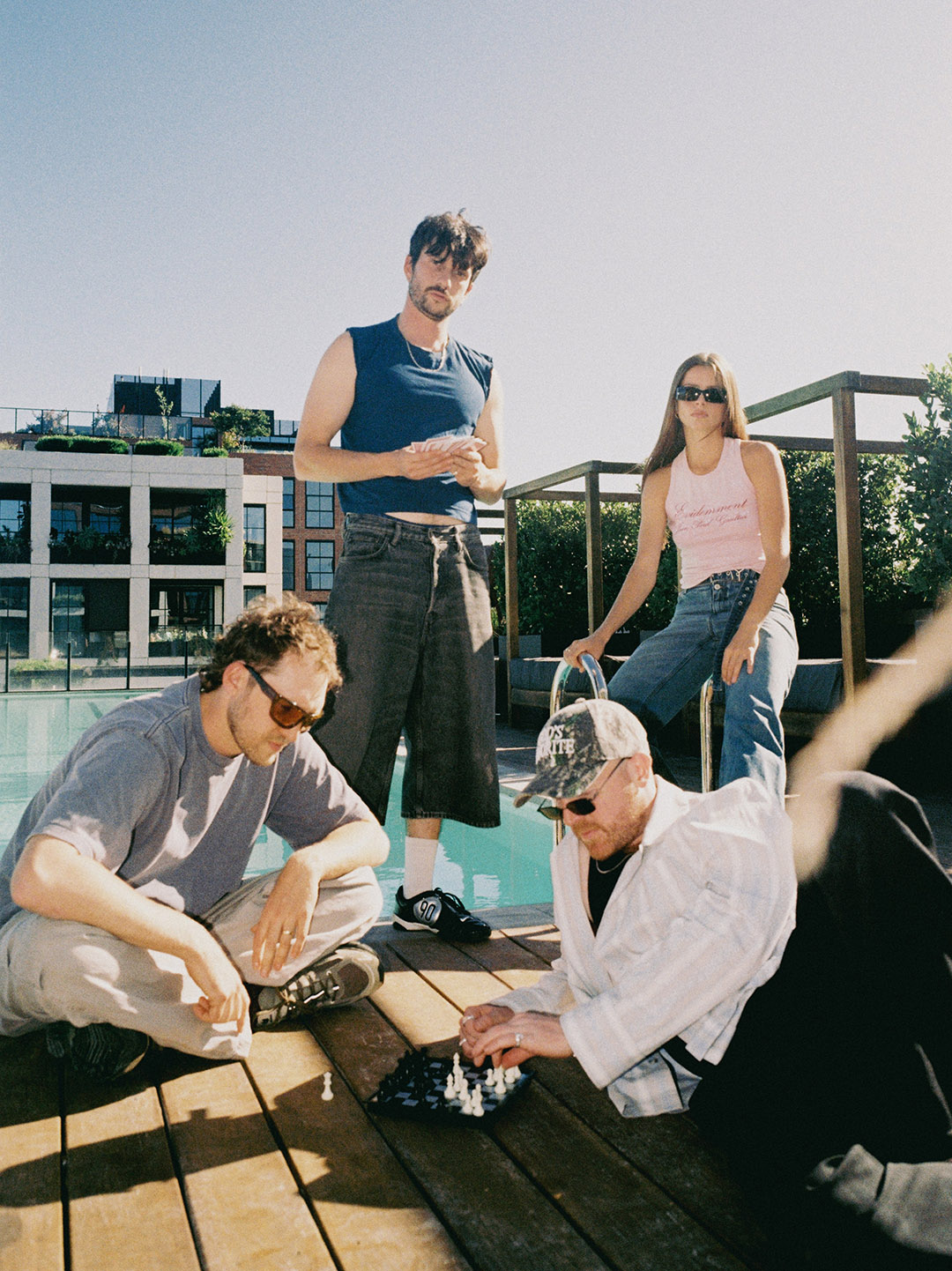
The Jungle Giants on Joy, Control and Saying What You Mean.
Sam Hales is moving studios when we speak, which means that somewhere in Australia his life is currently half-packed into boxes while, a few weeks out from another American tour, he is also preparing to unpack a record that took three years to understand.
– WORDS BY CJ • PHOTOS COURTESY OF THE JUNGLE GIANTS
It is Wednesday morning for him, still Tuesday in Texas… Hales is easy company, quick to laugh and happy to wander a little before coming back to the question, which proves useful once the conversation turns toward a record made during a period when wandering, creatively and otherwise, had become considerably less enjoyable.
The Jungle Giants have been doing this for fifteen years now, long enough that Hales can talk about earlier versions of the band almost as previous occupations. There are things he knows how to do. He knows how to build a song with enough rhythmic pull that the body gets involved before the brain has properly caught up. He knows when a chord progression feels good, when a bassline needs to move, when a production decision has tipped from clever into distracting. What became much less certain while making Experiencing Feelings of Joy was what any of those skills were supposed to be doing for him.
He worked on the record for three years, found himself buried somewhere in the middle of writer’s block, and then, after beginning Julia Cameron’s The Artist’s Way and starting to let go of some of the things that had been sitting heavily around him, finished it in about eight weeks.
“Once it all started flowing again, it felt joyful, it felt fun,” he says. “Things started making sense again.”
The title grew out of that feeling rather than any intention to make a cheerful record. Experiencing Feelings of Joy can sound ecstatic while carrying some fairly brutal thoughts around inside it, and on this record Hales is far less interested in hiding what those thoughts are.
“I would always in a shy way avoid the lyrics because I kind of felt like the true meaning behind this is private,” he says. Music could communicate the emotional information without requiring him to explain exactly where it came from. He could put the feeling into the arrangement and leave the source somewhere behind the curtain.
After years of writing that way, musical cleverness had stopped being the difficult part. “I was like, I’ve done this before.” So Hales started asking himself a different question: what is the hardest thing here? “Being exposed lyrically felt so difficult,” he says. “So I just dived into that.”
Instead of smoothing experiences into something safer, he began reconstructing them. He would think about the person involved, put himself back into the conversation and write as though they were sitting there with him. “What is this totally about?” became the question, and once he got far enough past the discomfort, telling the truth became easier than avoiding it.
“All you’re talking about is a real experience, the way you felt and what you heard in that moment.”
“Where Can I Put My Love” came directly out of that process, its title appearing while Hales was sitting with a guitar and trying to identify what, exactly, felt wrong that day. He had been experimenting with putting emotion directly into chords and structure when the words arrived with almost irritating clarity: where can I put all my love?
“I was like, ‘That’s totally it. I have nowhere. I don’t know what to do with all this.’”
The relationship had ended; the love had not. Hales describes walking around with it afterwards, still possessing this large and active thing that no longer had an agreed destination.
“I’ve been walking around with all this love since we broke up. I can’t put it away. I don’t know where to put it now.”
It is one of the simplest ideas on the album and one of its sharpest, partly because it refuses to solve the problem it identifies. Love rarely disappears on schedule just because the administrative side of a relationship has been taken care of.
Musically, Hales is still more than happy to disguise that kind of emotional damage beneath something you can dance to. He calls it “happy-sad,” a phrase simple enough to sound almost ridiculous and accurate enough that it hardly needs improving. The Jungle Giants have always understood the pleasure of contradiction: the gleaming beat carrying an ugly thought, the chorus that works perfectly in a festival field despite having been written somewhere far less communal.
“You can be like, ‘This is such a happy song,’ and then you read the lyrics and you’re like, ‘Wait. Fuck. What?’”
He laughs. “I’ve always loved that.”
The final song written for the record became its opener. “Tell Me How It Feels” grew out of Hales trying to work backwards through his own habits and instincts, asking why music occupies the place it does in his life and eventually arriving at his childhood and his mother. Hales was raised by a single mum, fiercely supportive of his interest in music, and the further he got into examining himself, the more obvious her influence became.
“She was so supportive in music,” he says. “That sent me on a trajectory for the rest of my life.” He talks about her with enormous warmth, particularly the way she can make somebody else feel safe while absorbing the cost herself. “If you’re in the center of a storm, she’ll make you feel calm.”
Then he adds, with enough affection to stop the moment becoming sentimental: “I think that’s the coolest, most badass shit ever.”
That loosening also reached the recording process. Love Signs, The Jungle Giants’ previous album, was almost entirely Hales: played, engineered and produced by him, what he now jokingly describes as “a guy in a box.” It gave him control down to the smallest decision, but this time he began to wonder whether control was always as useful as he had assumed.
He brought the band into the studio. They would play his arranged part first, then do another pass with permission to wander. Hales could still edit later, but now he was deliberately leaving room for decisions he hadn’t made.
“What was initially scary of relinquishing control actually ended up being like a really fun game,” he says. “I think everybody could feel like they could relax a little bit. And then I think I let myself relax a little bit too.”
That last sentence probably says as much about Experiencing Feelings of Joy as anything else.
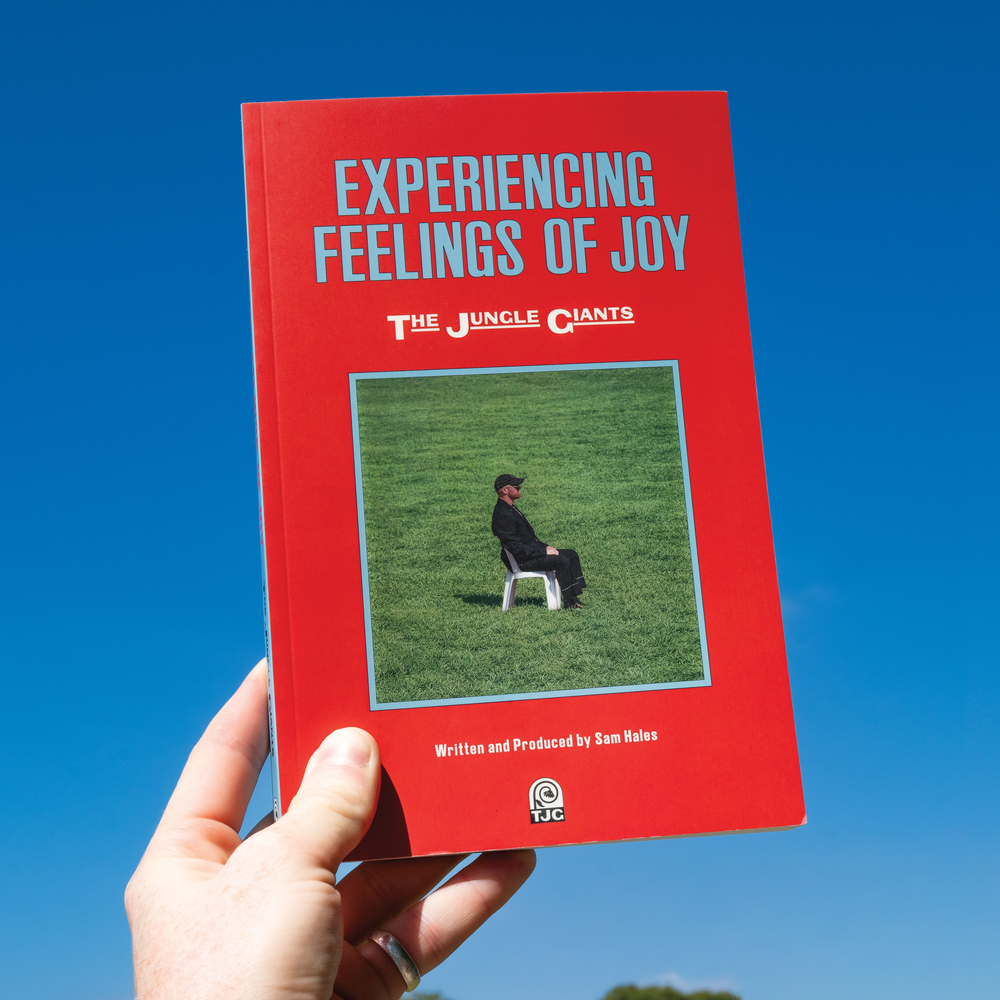
Experiencing Feelings of Joy was released on May 8th 2026
Hales has started wondering how much of his obsession with control was really fear in productive clothing. If he trusted his instincts enough to know he would ultimately make the record as good as he could, maybe he could afford to leave some fingerprints behind.
“So I can afford to show the seams a little bit.”
His relationship with work itself has undergone a similar revision. Hales admits his work-life balance used to be “so shit,” the kind of schedule where touring Thailand could retrospectively be filed as a holiday because technically he had been in Thailand. The Artist’s Way forced him to reconsider that accounting system.
Now he sometimes deliberately doesn’t write.
“Old me would’ve freaked the fuck out.”
Instead, he makes playlists. One current favorite is specifically for afternoon walks with the dog. The point is almost aggressively ordinary: listen, walk, notice things, allow a thought to exist without immediately requiring it to become useful.
“I’m trying to build up some intention.”
The new songs are already changing again now that people are standing in rooms with them. The band recently finished an Australian tour, and Hales has been watching audiences closely, fascinated by which tracks behave exactly as expected and which refuse the instructions. “A Moment Like That,” one of the album’s most immediate dance songs, surprised him.
“They’re reacting through the music and they’re dancing.”
Hales likes reading the room, noticing that different cities understand different songs in different ways. After spending three years trying to work out what these songs meant to him, he seems delighted by how quickly those meanings stop being entirely his problem.
Before the album came out, he told drummer Keelan that once it was released, it belonged to everybody else as much as it belonged to them.
“It’s completely yours and it’s everyone else’s.”
That becomes stranger the longer a band exists. Fifteen years is enough time for songs to attach themselves to marriages, breakups, awful apartments, good summers, dead friendships, new countries and thousands of other experiences their writer will never hear about. Hales can stand onstage having long since moved beyond whatever originally produced a lyric and look down at somebody currently living directly inside it.
His response to that distance is unusually generous.
“It has to be all forgiveness.”
The listener hearing a breakup song today does not need to be where Hales was when he wrote it. Songs move between people precisely because nobody receives them under identical circumstances.
“Just celebrate the connection when it happens.”
For Hales, Experiencing Feelings of Joy seems to have provided permission more than resolution. He already has two ideas for future Jungle Giants projects, apparently so different from one another that the sensible response would be to choose between them.
He wants to make both.
The response to this record has given him what he calls “a big green tick” for going further rather than retreating. More honesty. More experimentation. Less punishment. A little less certainty about how everything is supposed to turn out.
“I feel like I’ve opened up a Pandora’s box here,” he says. “I just wanna keep going further in.”