INTERVIEWS
The Mary Wallopers: Tradition Is Supposed to Move.
There is a particular danger that comes with deciding a kind of music is important. Eventually somebody starts talking about preservation, somebody else starts worrying about authenticity, and before long the songs stop behaving like songs and start behaving like objects behind glass.
– WORDS BY CJ
The Mary Wallopers have never seemed especially interested in the glass. For Andrew Hendy, Irish traditional music survived precisely because people kept passing it around, changing it and letting whatever else they were listening to rub against it. “Any great leap that’s happened with the music before has been from people who broke the rules of what’s considered traditional and what’s considered okay,” he says. “Nostalgia’s a dangerous thing.”
The American comparison he reaches for is country music. Willie Nelson and Waylon Jennings did not destroy the thing by pushing against what country was supposed to sound like, any more than Planxty betrayed Irish music by putting bouzoukis and guitars beside uilleann pipes. What becomes tradition usually started with somebody annoying the traditionalists. “If you’re interested in music for its artistic side and its artistic expression, you can’t just play the same music that people have played before.” The Mary Wallopers never really decided to modernize anything. They grew up with the ballads, but also hip-hop, punk, dancehall, country and techno, and pretending none of that entered the music would be less honest than simply letting it happen.
Andrew is suspicious of the way music gets compartmentalized, particularly when the language around a band tells you exactly what it is before you have heard it. Folk. Punk. Traditional. Political. Irish. “Realistically speaking, an honest expression cannot be one genre,” he says. Irish folk music sits at the center of what The Mary Wallopers do, but they make it as people born in the 1990s who have spent their lives absorbing everything else. The same goes for the humor. There is plenty of anger in the songs — housing, rent, work, political power — but the band have never seemed interested in standing onstage and explaining everybody’s misery back to them.
“Almost a bigger tradition in Ireland is the dark humor and satire,” Andrew says, “and using humor to deal with grief and trauma.” For generations who were not encouraged to talk about what was happening inside their heads, jokes became their own kind of emotional technology. Something awful happens and somebody says the funniest possible thing about it before the room gets too quiet. “When we’re singing songs about society or the cost of living or the housing crisis, we don’t want to lecture people.” Folk music can carry fury, sentimentality, stupidity, grief and a punchline in the same song without announcing when one has become another.
That elasticity is why The Mary Wallopers can make sense to people arriving from completely different directions. Older listeners recognize songs they have carried around for decades, while somebody from a punk or alternative background can hear the same thing as if it has just been invented.
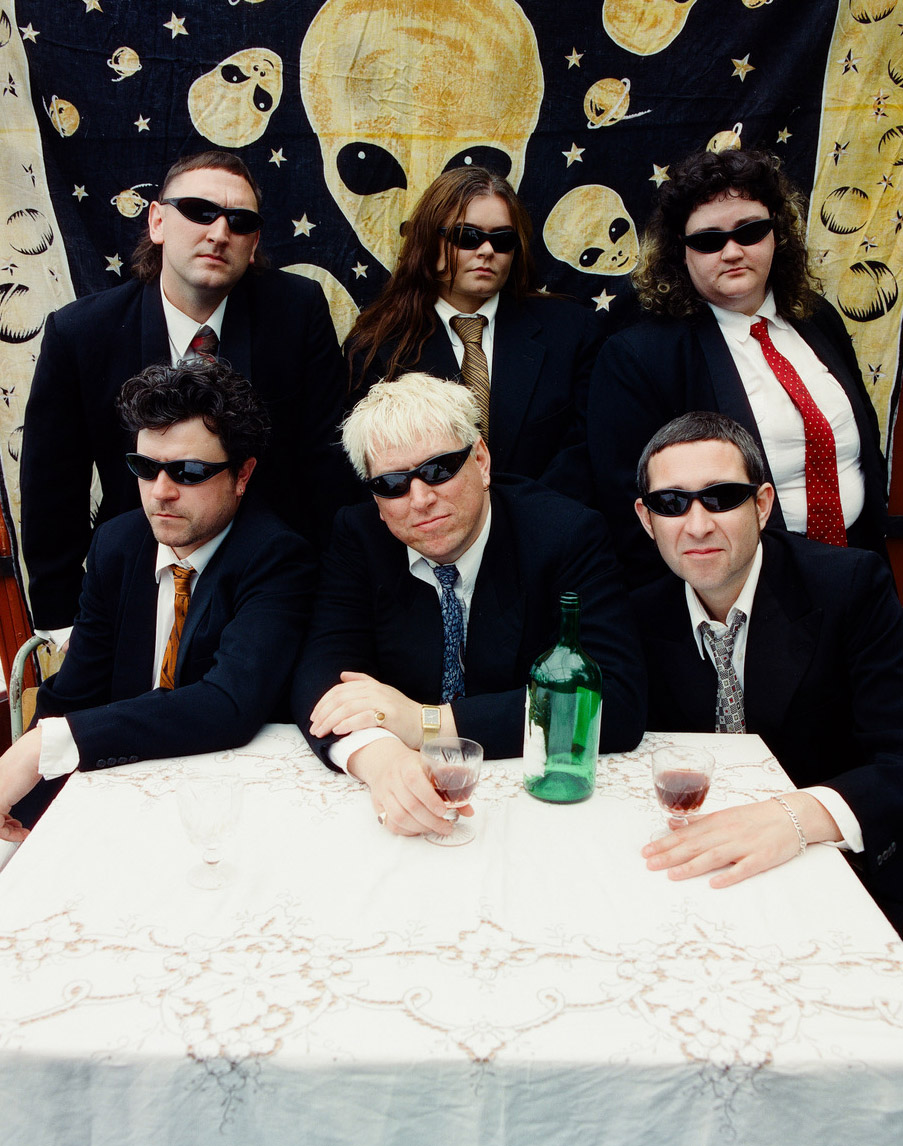
Photo by Tom Beard
In America, country music offers another route in. “People who like country music can like Irish music very easily because it’s relatable stories that are rooted in honesty,” Andrew says. Leaving Ireland has also forced the band to think differently about Irishness itself, particularly when encountering Irish-American culture as something connected to home but no longer identical to it.
The first American tours were an education. Boston and New York revealed traditions that had developed independently over generations, sometimes preserving things that had vanished in Ireland while inventing others nobody back home would recognize. Andrew does not dismiss any of it. “They’re every bit as Irish as we are,” he says. At the same time, he is wary of what happens when identity becomes costume. Irishness has become fashionable again, particularly in Britain, and some of that tension sits inside the title Paddywhackery. “We’re in this Celtic Tiger of Irish identity where everyone’s kind of flaunting the fact they’re Irish.” The pride is good. Becoming unbearable about it would be less so.
There is a similar contradiction in romanticizing Irish history while quietly removing the politics of the people being romanticized. Rebellion can become aesthetic from a distance while the socialist ideas held by many revolutionary figures are conveniently left outside the picture. The songs carry history whether anyone wants them to or not, but a Mary Wallopers show has never felt much like a history lesson. If anything, it has more in common with a football terrace that somebody accidentally gave instruments to. “This music is everybody’s,” Andrew says. “It’s ours, but it’s also yours.”
Some of that comes from folk music and some from punk, where the distance between the person holding the microphone and everyone else in the room is supposed to remain suspiciously small. “We’ve definitely set out to demystify musicians,” Andrew says. The proof often comes after the concert has finished. Thousands left a Sydney show still singing “Dirty Old Town,” with the same thing happening in Glasgow, London and New York. The band stops but the room does not seem ready to hand the songs back. “We really, really do just want to encourage people to sing because everyone can do it, and it’s actually a therapeutic thing to sing, especially if you’re frustrated.”
That last word matters. If you are being crushed by rent, working longer for less and watching wealth accumulate somewhere you cannot reach, there is a version of political music that simply tells you about those things all over again. The Mary Wallopers would rather give you somewhere to scream. “Instead of just wallowing in all this stuff, you can be elated by singing your heart out and jumping around going mental.” At Electric Picnic, tens of thousands were singing with them when the rain came down and the crowd started throwing mud at each other. Andrew calls it “feral energy,” a brief abandonment of the restraints of everyday life. Bigger crowds have not diluted that feeling. They have made it stronger.
The band itself has inevitably changed around those rooms. There are more members now, the set has become more rock and roll, and some slower songs have made way for things capable of moving a festival field. Andrew is not worried about protecting some pure original version of The Mary Wallopers, because that would undermine the point.
Photo by Sorcha Frances Ryder
“I don’t think the essence of what we are will ever really change if we just keep doing whatever we feel drawn to do artistically.” The biggest shift may be that they are now increasingly playing their own songs beside the ones that first taught them how to be a band.
For years, that prospect created a particular kind of imposter syndrome. It is one thing to write a song; another to put it beside material refined through generations of people singing it to one another. Andrew describes the old songs as “big, big old trees,” while anything new feels like planting a tiny sapling beside them. Paddywhackery changes that balance, with original material now making up most of the record, and those songs offer a freedom the old ones cannot. “There’s no what the song was before if we wrote the song,” Andrew says. “We’re just making a song.”
The confidence arrived once they started playing those songs to people who had no reason to indulge them. Festivals in Poland and the Czech Republic put the band in front of thousands who barely knew The Mary Wallopers, let alone the unreleased material. The new songs landed as hard as the established ones. No polite lull, no collective waiting for something familiar. That matters when the material beside you has already survived longer than anybody in the band has been alive.
Community, for The Mary Wallopers, also means something when it becomes inconvenient. When their set at Victorious Festival was cut short, several artists subsequently withdrew in solidarity. Andrew is careful about the difference between support that costs nothing and support that requires somebody to give something up.
It would be easy to separate all of this into different versions of The Mary Wallopers: the traditional band, the political band, the funny band, the punk band, the Irish band. Andrew’s argument is that none of those divisions make much sense. The old songs sit beside the new ones, jokes beside anger, history beside whatever happened last week, and the audience is expected to become part of it rather than merely witness it. By the end of the conversation, he offers the simplest explanation possible: “Traditional Irish folk music meets rock and roll and punk rock. And our live shows are extremely fun.”
After everything else, it sounds almost suspiciously straightforward.
But maybe that is the point. Tradition does not survive because people guard it closely enough. It survives because somebody still wants to sing it.