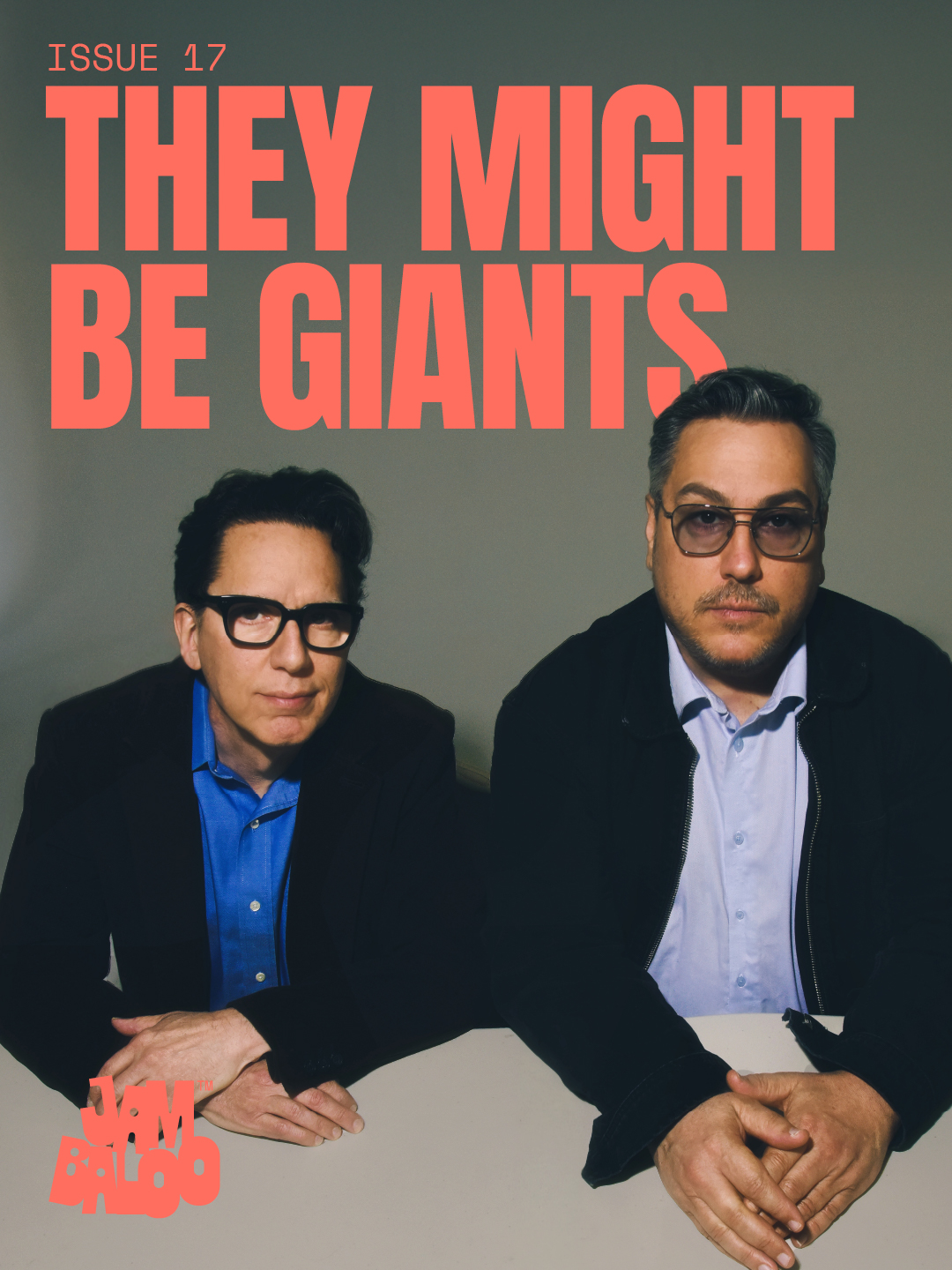
Photo by Miranda Penn Turin
FRONT & CENTER
John Flansburgh on They Might Be Giants, Forty Years of Songs, and the Art of Keeping Things Interesting.
With a new album in the world and two Dallas shows approaching, the They Might Be Giants co-founder talks about humor, pop music, unlikely influences, and why playing it safe onstage has never appealed to him.
– WORDS BY CJ
“There’s nothing good about being in a band for 40 years,” John Flansburgh says playfully, before allowing himself one exception. “The one thing that is great about being in a band for 40 years is you’ve got a huge stack of really good songs.” For They Might Be Giants, the band he formed with John Linnell in the early 1980s, that stack has become substantial enough to make a conventional concert seem like a missed opportunity. On their current Texas run, the band expects to play around 85 songs across six shows, with sets that can change radically from one night to the next. When they reach The Echo Lounge & Music Hall in Dallas for two nights on November 13 and 14, Flansburgh is looking forward to the challenge as much as anything else.
Their latest album, The World Is to Dig, arrived in April with 18 songs full of bright melodies, peculiar characters, unexpected turns and lyrics that reward extra attention. There is a tendency to describe They Might Be Giants through their eccentricity, which is understandable but only gets you part of the way there. Across four decades, Flansburgh and Linnell have been unusually consistent in making strange ideas work as direct, memorable pop songs. The record’s title invites a closer look, although Flansburgh is more interested in the work involved in making those different elements fit together.
“We’re always exploring technology stuff,” he explains. “Sometimes they’re dead ends, but there’s all sorts of stuff, new ways of creating music that are kind of tantalizing.” He regards that as the equipment side of the equation. Songwriting presents a more persistent problem. “We’ve kind of set ourselves up with a sort of a Sisyphean challenge to just keep on going and keep on trying to take it to another level.” What makes that difficult, he suggests, is the particular combination they have committed themselves to. “I think it’s very hard to balance humor and melody and song structure together successfully. A lot of times humor songs don’t really hold up to repeat listening.”
Flansburgh reaches for an unlikely comparison. He knows a musician who spent years working in restaurants and learned to make an exceptional cheesecake. Once you know how to make something that good, he reasons, you keep making it.
He sees They Might Be Giants as having found a similarly satisfying solution to a songwriting problem. The joke is never quite the whole point, and the melody has to survive after the surprise wears off. He finds it peculiar that so many naturally funny musicians become intensely solemn the moment they begin writing songs, as though music has to announce its importance.
Photo by Miranda Penn Turin
He respects U2 for working out how to speak to an enormous audience, while recognizing that They Might Be Giants are attempting something else entirely.
The conversation drifts toward the Beach Boys and what people choose to regard as serious music. Flansburgh’s teenage introduction was Endless Summer, the hit-packed compilation of surf and car songs. Rock criticism told him Pet Sounds was an artistic landmark, but he struggled to imagine how the group that made “Be True to Your School” had arrived there. He finally heard Pet Sounds in his late twenties and became “hypnotized by that record.” The discussion turns to Carl Wilson’s singing on Wild Honey, which Flansburgh admires because Wilson bravely reaches outside his range. A cautious singer might have moved the song down a couple of steps, but Flansburgh loves the urgency of leaving it alone.
From the Beach Boys, the discussion somehow reaches Wu-Tang Clan, a transition made easier by the new They Might Be Giants song “Wu-Tang.” A documentary about the rap group’s notorious one-of-a-kind album raises questions about what Linnell is doing with the subject. Flansburgh is careful not to claim the song’s meaning on his bandmate’s behalf, but hears it as a recognizable They Might Be Giants character study. “I think that’s a kind of a classic They Might Be Giants unreliable narrator song,” he says, before entertaining the possibility that the narrator might be reliable. Listeners often assume the voice in a song must be the songwriter speaking personally. “People are so used to songs being first person singular, dear diary kind of direct address songs.” Linnell, he suggests, was intrigued by the documentary and by the intensity that fandom can acquire
The internet has amplified that intensity, creating hyper-fans for practically every niche imaginable. It also makes Flansburgh wonder how anyone discovers an artist who resists easy classification. “I wonder if I didn’t know about They Might Be Giants, if I would be able to get to They Might Be Giants,” he says.
Photo by Shervin Lainez
“For a long time I think we were the strangest thing in the mall record store.” He remembers Frank Zappa and Captain Beefheart occupying that position when he was young, and considers it an honorable place to land. Being present in the record store at least made discovery possible. Whether a description of his own band would persuade him to click on it today is another question. He admits that he would like them to be more popular, but seems uncertain how he would explain what they do to someone coming to it cold.
There is, however, a new generation finding its way in. Flansburgh has noticed teenagers who grew up with They Might Be Giants’ children’s records as the “background radiation” of childhood, then discovered the adult catalog and become committed fans. He likens it to teenagers in the mid-1990s becoming Beatles obsessives decades after that band split up. His own attachment goes back considerably further. At five years old, he took the five-dollar bill his grandmother had sent for his birthday, went to a record shop with his father and bought A Hard Day’s Night. “It was a life-changer for me,” he remembers. For him, new generations of listeners finding old music is a familiar pattern.
Flansburgh’s musical education took him from the Beatles through glam rock and punk, but They Might Be Giants came up through a distinctly American alternative circuit of college towns, second cities and exhausting tours. The duo also played extensively in Germany, where reviews sometimes presented them as radical political provocateurs. “John and I are sort of thinking, were we kind of just guys who watched too much TV?” he recalls. He found the interpretation flattering but bewildering, another example of how differently a song can land once it leaves its creators’ hands.

Photo by Shervin Lainez
Their career has also been shaped by the age at which they started. “We’ve been adults the entire time,” Flansburgh says. They already had jobs and lives when the band began; they were not teenagers suddenly required to figure out adulthood in public. He remembers appearing on Top of the Pops at 30 and being able to relate to the camera crew while many of the performers were much younger. When the conversation reaches Oasis, Flansburgh expresses admiration for Liam Gallagher’s vocal attitude, which he hears as a combination of John Lennon and Johnny Rotten. “It’s really persuasive,” he says.
Technical neatness is not the priority at a They Might Be Giants show, either. Flansburgh describes the current format as the band opening for itself. The first set draws from a rotating selection of albums, leaning into material for the particularly devoted fans at the front.
The second is a more exuberant, festival-ready stretch. The expanded band gives them room to move, and Flansburgh is happy to admit that they have deliberately surrounded themselves with players of exceptional ability. There is extensive rehearsal, but also improvisation and enough repertoire to make each night a serious test of concentration. “Sometimes it’s more than we can handle,” he says. “It’s hard to be standing on your toes every night. But it’s way better to err on that side of things than to be bored of yourself.”
He has seen bands deliver almost identical shows at the beginning and end of a tour, and still sounds perplexed that they would not take the opportunity to change something. Worse, he thinks audiences can sense a performer going through the motions, even when the playing itself is perfect.
“People can totally tell when a performer is bored,” he says, comparing that feeling to “putting poisonous gas in the vents of the theater.” For Flansburgh, maintaining a huge, changing set list is a practical way to keep the musicians engaged with the songs, rather than simply reproducing a performance they perfected months earlier. It also means that someone attending both Dallas nights should hear two markedly different evenings from a band still willing to make its own life difficult.
Near the end of the conversation, Flansburgh asks about the room in Dallas and is pleased to hear that The Echo Lounge & Music Hall keeps an audience close to the stage. “No matter how big a place is, if the crowd is really right up on you,” he says, “that really changes the pH balance of doing shows.” After a conversation that has wandered through the Beach Boys, Wu-Tang, punk rock, German music journalism and four decades of They Might Be Giants songs, he is still thinking about what a live show looks and feels like from another angle.